Bangkok is a city that earns more time than most visitors give it, but even the most committed urbanite occasionally benefits from a day somewhere else. The good news is that Bangkok's position in the centre of the country makes it an unusually practical base: ancient capitals, WWII history, mountain waterfalls, and – yes – markets where trains pass through the middle of the stalls are all within two to three hours. This guide covers the strongest options, ranked by how worth the effort they actually are, with transport details and an honest account of what to expect when you arrive.
Ayutthaya was the capital of the Kingdom of Siam from 1350 until 1767, when Burmese forces destroyed it with sufficient thoroughness that it was never rebuilt. What remains – spread across a small island encircled by three rivers, now a UNESCO World Heritage Site – is one of the more atmospheric collections of ruins in Southeast Asia: headless Buddhas scattered across temple grounds, great prangs (pointed towers) partially collapsed, the whole complex given over to banyan trees and long grass in a way that no amount of heritage tourism management has entirely tamed.
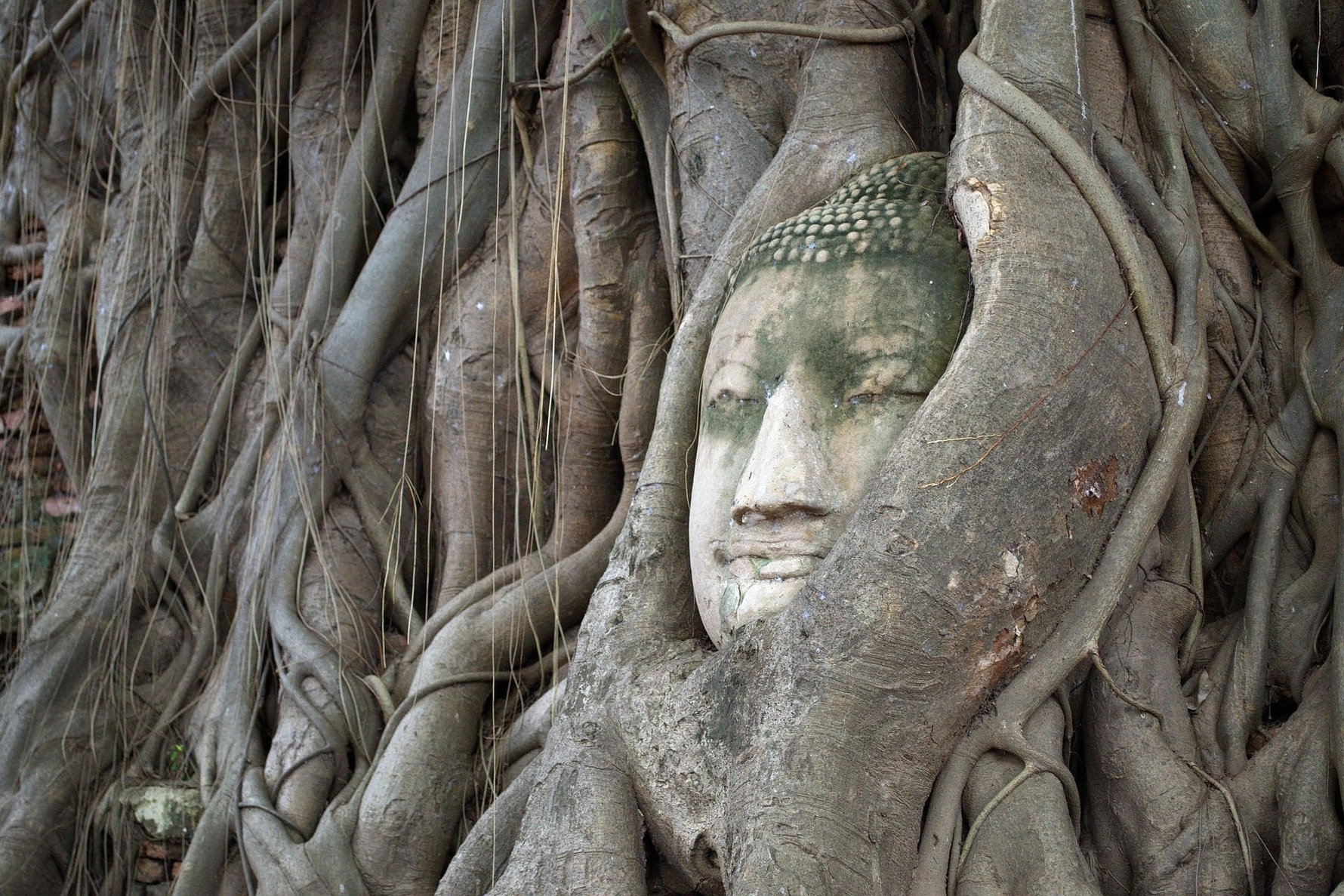
The image most people associate with Ayutthaya – a stone Buddha head enveloped in the roots of a bodhi tree at Wat Mahathat – is real and worth seeing, though the crowds around it have grown considerably. The more impressive temples are arguably Wat Phra Si Sanphet, with its three large chedis in a row that served as the model for Bangkok's own Wat Phra Kaew, and Wat Chai Watthanaram on the river's edge, which has a grander scale and rather fewer people photographing it from five centimetres away.
Getting there: The train is the right choice. Trains run from Hua Lamphong station and the newer Krung Thep Aphiwat (Bang Sue Grand) station, with ordinary trains taking around 1.5–2 hours and costing 15–35 THB in third class. Third class has no air conditioning but has windows and fans, and the journey is short enough to be perfectly manageable. The train station sits on the eastern bank of the river, a short tuk-tuk ride from the historical park – budget 80–100 THB for this crossing. Minivans from Mo Chit bus terminal are faster (around 90 minutes) and cost 60–100 THB; convenient if you're coming from the Chatuchak or northern Sukhumvit side.
Getting around Ayutthaya: The temples are spread across a large area and are not walkable in any serious heat. Bicycle rental near the train station costs around 50–80 THB per day and is the best option – it gives you full flexibility and the pace feels right for ruins in a landscape. Tuk-tuk drivers at the station will offer a full-day rate of around 600–800 THB to visit the major sites; useful if you're short on time or the heat is serious. A park pass covering six temples costs 220 THB and represents good value over individual entry fees of 50 THB each.
When to go: Early. The heat and the tour buses both peak between 10am and 2pm. Arriving on the first or second train of the morning (departing Bangkok around 6–7am) gives you the ruins to yourself for the best hours of the day. All entries and fees are current as of early 2026 – verify before travel.
Kanchanaburi: History and Waterfalls
Kanchanaburi, around 130km northwest of Bangkok, makes a case on two completely different grounds that happen to coexist in the same province. The first is the Death Railway – the railway built by Allied POWs and Asian conscript labourers under the Japanese occupation during World War II, at a cost of somewhere between 90,000 and 100,000 lives. The Bridge over the River Kwai is here (the actual river is the Khwae Yai, not the Kwai – that name was applied by the film), as is the Kanchanaburi Allied War Cemetery, where nearly 7,000 POWs are buried. The JEATH War Museum provides context on the conditions. Hellfire Pass – the most brutal section of the railway, cut through rock by hand – is a further hour from town, quieter, and more affecting.
The second argument for Kanchanaburi is Erawan National Park, around 65km from town: a seven-tiered waterfall system with turquoise pools at each level, fish that nibble at your feet if you sit still, and enough jungle to feel genuinely remote. It is legitimately beautiful. Most tours give you two hours here; this is not enough time to reach the upper tiers and is one of the most consistent complaints in visitor reviews. Three hours is better, and if you have to choose between reaching the top or spending another hour in the lower pools, go up.
The honest note: combining both the historical sites and Erawan in a single day trip makes for a long and tiring day. Kanchanaburi works better as an overnight. If you're doing it as a day trip, choose your priority – the WWII history or the waterfalls – and weight your time accordingly rather than rushing both.
Getting there: The most practical day trip option is a guided tour from Bangkok, which handles the logistics and covers 130km each way without the complexity of public transport connections. Independent travel is possible via bus from Southern Bangkok Bus Terminal (Mo Chit doesn't cover this direction) or the scenic but slow train from Thonburi station, which crosses the Death Railway viaduct at Tham Krasae and offers beautiful river views but departs only twice daily and doesn't reach Erawan. Budget around 2–2.5 hours driving each way. Tours typically depart at 06:30 to preserve time at the destination. The Erawan National Park entrance fee is 300 THB for foreign visitors – check whether this is included before booking any tour.
Maeklong Railway Market and Amphawa
These two are most commonly combined, and there is a good argument for doing so on a Sunday when both are operating.
The Maeklong Railway Market is exactly what it sounds like: a working fresh market built along an active railway line, where vendors extend their stalls and umbrellas across the tracks and retract them several times daily when a train comes through. The whole operation – awnings folding, produce shuffled back, the train squeezing through with what looks like impossible clearance, then everything re-extending within seconds – takes about five minutes and is genuinely worth seeing. Trains pass at 8:30am, 11:10am, 2:30pm, and 5:40pm; arrive 20–30 minutes before your target time for a decent position.
The market itself is a real working market selling fresh produce, seafood, and local food – not tourist-oriented in the way the floating markets can be. This is part of what makes it more satisfying than it might sound from a description.
Amphawa Floating Market, around 15–20 minutes from Maeklong, operates on Friday, Saturday, and Sunday afternoons into the evening – uniquely among the area's floating markets, it is primarily patronised by Thais rather than tourists, and it comes alive after dark when the lit-up canal vendors are doing a brisk trade in grilled river prawns and seafood. This is the floating market we'd recommend over Damnoen Saduak (see below) if your trip falls on a weekend.
Getting there: Minivans from Victory Monument (around 70 THB) reach Maeklong in 90 minutes. From Ekkamai Bus Terminal, vans depart for Maeklong approximately every 90 minutes from around 7am, costing 100 THB. Organised tours combining both markets handle the transport and timing, which is genuinely useful given the train schedule dependency.
The Floating Markets: Worth the trip?
The floating markets of the Bangkok region – primarily Damnoen Saduak and Taling Chan, with Amphawa as covered above – are among the most photographed attractions in Thailand and among the most frequently disappointing on arrival. This is not because the concept is wrong. It is because Damnoen Saduak, 100km southwest of Bangkok and the most famous of them all, has been so thoroughly optimised for tour groups that the experience is now largely one of being on a boat surrounded by other boats of tourists, with vendors who have been photographed so many times that their engagement with the whole enterprise has become performative. It is still colourful. The longtail boat ride through the canals has its own momentum. But it is a long way from authentic, and anyone expecting to feel like they've discovered something should probably recalibrate.
Taling Chan, 15km west of Bangkok on the Chao Phraya canals, is the most accessible floating market and makes a viable half-morning without the two-hour journey. It is weekend-only, smaller, and considerably more local in character – working Thais eating lunch on weekend boats rather than a tour group destination. If you're after the general experience and don't have a full day to spare, this is the more honest value.
Our verdict: Skip Damnoen Saduak unless you actively want the full tourist version of the floating market experience, which is a legitimate choice. Do Amphawa on a weekend evening. Consider Taling Chan for a short, accessible, lower-expectation version. Save the day trip time for Ayutthaya.
Bang Pa-In Royal Palace
Often combined with Ayutthaya – it's a 20km detour on the way – Bang Pa-In is the former summer palace of the Chakri dynasty, a curious and rather appealing architectural jumble of Thai, Chinese, Gothic, and European styles arranged around ornamental lakes. It lacks the emotional weight of the Ayutthaya ruins but is visually distinctive and considerably quieter. Worth including if you're making the Ayutthaya trip independently with your own transport; less essential if you're trying to pack as much into the temple-viewing hours as possible.
Khao Yai National Park
The furthest destination on this list at around 200km northeast of Bangkok, Khao Yai is Thailand's oldest national park and one of the most significant wildlife areas in Southeast Asia: elephants, gibbons, hornbills, and an ecosystem that makes a strong case for spending longer than a single rushed day. The standard day trip covers some trail walking and scenic viewpoints; the honest argument is that the real rewards of Khao Yai – wildlife encounters, the famous bat cave at dusk, night safaris – only materialise if you stay overnight. As a day trip it is a long drive for moderate return. As an overnight it is excellent. If you have the time to add a night before returning to Bangkok, it earns a strong recommendation; as a single day it is a stretch. Early access to the park before tour buses arrive makes the most difference if you're committed to the day trip format.
Practical Notes
Most day trips from Bangkok are best started early – the combination of Bangkok's morning traffic and Thailand's midday heat means that every hour bought in the morning is worth two in the afternoon. For Ayutthaya and Kanchanaburi especially, being at your destination before 9am makes a material difference to what you get out of it.