This is one of the most common questions in the Kathmandu Valley, and it deserves a direct answer rather than the usual diplomatic shrug of "both are wonderful in their own way." So: if you only have time for one, go to Patan. If you have time for both, go to Patan first and then Bhaktapur. And if you've already been to Patan and are trying to decide whether Bhaktapur is worth the extra effort and entry fee – yes, it absolutely is.
Now for the reasoning, because the choice is more nuanced than that one-liner suggests, and which city suits you better depends quite a bit on what you're actually looking for.
But the real case for Patan is the Patan Museum, which is, by a considerable margin, the finest museum in Nepal. Housed in the beautifully restored Keshav Narayan Chowk – one of the old royal palace courtyards – it documents the sacred arts of Nepal with a depth, intelligence, and quality of curation that is startling in context. Bronze sculptures, gilt copper figures, explanations of the iconography and techniques behind Newari metalwork: it puts the entire artistic tradition of the valley in context in a way that transforms every subsequent temple you visit. If there is one museum in Nepal worth going out of your way for, this is it. The entry ticket (NPR 1,000 for foreign nationals) covers both the museum and the Durbar Square.
Patan Durbar Square itself is the finest of the three valley squares – more coherent, more beautifully proportioned, better restored than Kathmandu's earthquake-damaged complex. The Krishna Mandir, built entirely of stone in the Shikhara style in 1637, is unlike anything else in the valley. The Sundari Chowk behind the museum holds the exquisite Tusha Hiti step-well, a 17th-century royal bath ringed with stone and gilt figures of gods and nagas that is one of the most quietly astonishing things in Kathmandu. Most visitors walk past it too quickly.
Beyond the square, Patan rewards wandering. The surrounding streets contain Buddhist bahals (monastery courtyards), metalwork workshops producing the high-quality bronze and gilt work that Patan has been famous for since the Malla period, and some of the better cafés and restaurants in the valley. It's a city with a genuine arts scene and an increasingly good food culture. An afternoon here can expand into an easy full day without effort.
The cars are largely absent from the historic core. The scale is human. The urban fabric is largely intact – old brick houses with carved windows, temple courtyards, local shops rather than souvenir emporiums. When Bhaktapur works, which it does most of the time, it produces the genuinely rare sensation of time having made its own arrangements.
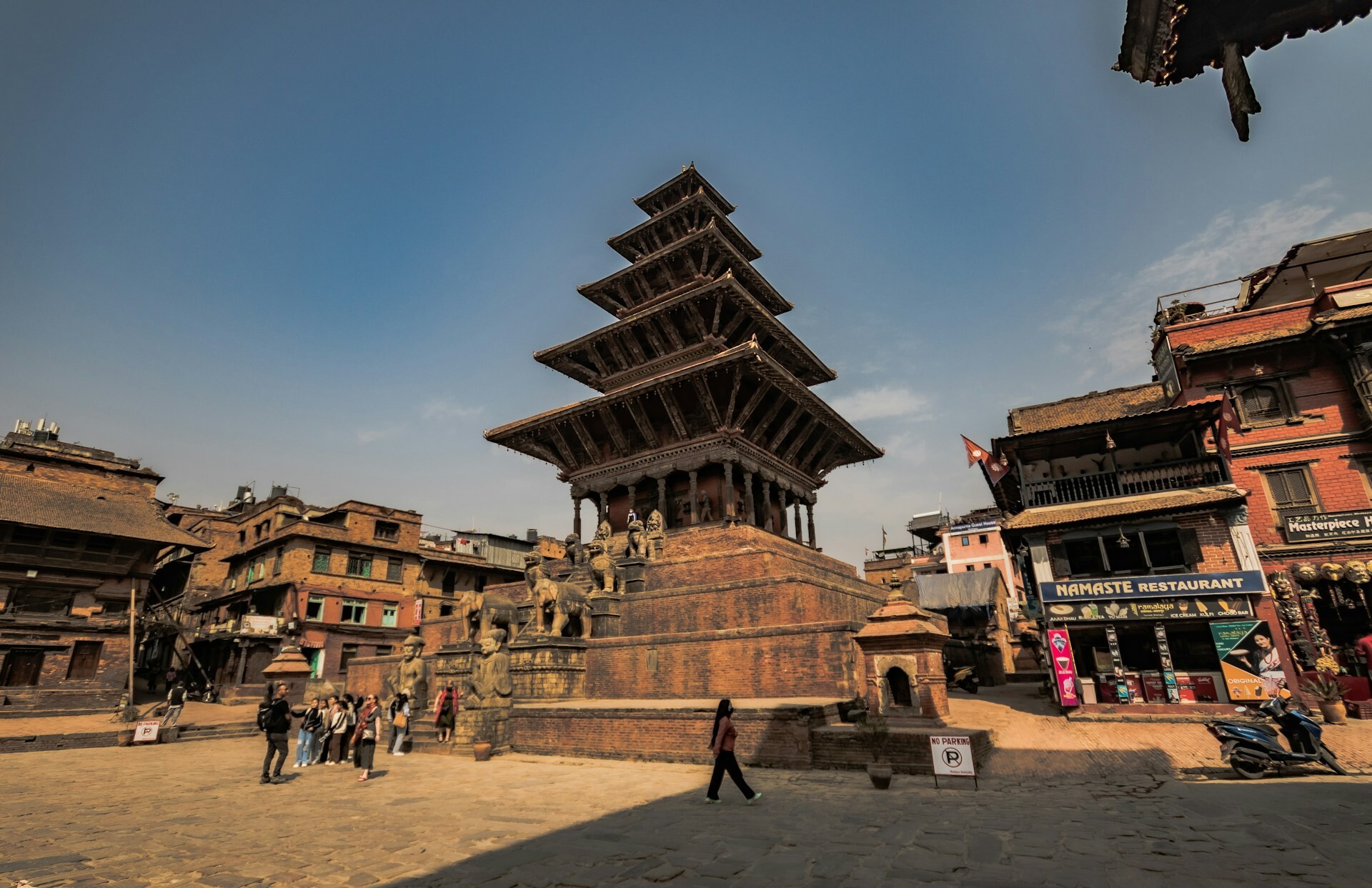
The Nyatapola Temple in Taumadhi Square – a five-storey pagoda from 1702, the tallest traditional structure in Nepal, virtually undamaged by the 2015 earthquake – is one of the great sights of the valley. The 55-Window Palace is a masterpiece of Newari woodcarving. The Pottery Square, a short walk from Durbar Square, is a working potters' quarter where locals shape clay vessels on traditional foot-wheels and leave them to dry in the sun, exactly as they have for centuries. Bhaktapur's juju dhau – a sweetened, thick king curd sold in clay pots – is one of the better things to eat in Nepal and available only here.
The entry fee (US$18 or NPR 1,800 for foreign nationals) is higher than Patan and sometimes provokes complaints. It shouldn't. It covers the entire historic city area, is valid across multiple consecutive days, and funds preservation work that has kept Bhaktapur looking the way it does. It's worth it without qualification.
The one honest caveat: Bhaktapur is 14 kilometres east of central Kathmandu, which means a 30–45-minute taxi ride each way and a full day's commitment. It doesn't work as a quick half-afternoon. You need to give it time, which means it naturally requires more planning than Patan. Most people who rush Bhaktapur wish they had stayed longer; almost nobody who stays long wishes they had rushed.
Entry fees: Patan NPR 1,000 (includes museum). Bhaktapur US$18/NPR 1,800 (covers the whole old city, multiple days).
Time needed: Patan's Durbar Square can be covered in 2 hours, but a proper visit with the museum and surrounding streets takes 4–5 hours. Bhaktapur merits a full day. Both can be combined into one long day, though it makes for a tiring one.
Food and cafés: Patan has better restaurants and coffee. Bhaktapur has the juju dhau and several pleasant spots around Taumadhi Square.
Crowds: Bhaktapur is the more popular destination for organised day tours, which means tour groups arrive mid-morning. Going early – aim to be there by 8am – is the single best thing you can do to see it at its most atmospheric and its least congested.
If you visit Nepal primarily for culture and heritage, you should see both. If you genuinely only have time for one and have no particular museum interest, Bhaktapur is the more visceral experience. If the museum matters to you – and if you're spending any time in the valley, it should – go to Patan first.
For more detail on both, see our guide to the UNESCO World Heritage Sites of the Kathmandu Valley. For transport, entry fees, and practical logistics, see our Getting Around Kathmandu guide.
Now for the reasoning, because the choice is more nuanced than that one-liner suggests, and which city suits you better depends quite a bit on what you're actually looking for.
The Case for Patan
Patan (officially Lalitpur) is the closest of the three royal cities to central Kathmandu – about 5 kilometres south across the Bagmati River, easily reached by taxi in 20–30 minutes from Thamel. That proximity is one argument in its favour; you can slip across, spend a few hours, and be back in time for dinner without the logistics of a full-day excursion.But the real case for Patan is the Patan Museum, which is, by a considerable margin, the finest museum in Nepal. Housed in the beautifully restored Keshav Narayan Chowk – one of the old royal palace courtyards – it documents the sacred arts of Nepal with a depth, intelligence, and quality of curation that is startling in context. Bronze sculptures, gilt copper figures, explanations of the iconography and techniques behind Newari metalwork: it puts the entire artistic tradition of the valley in context in a way that transforms every subsequent temple you visit. If there is one museum in Nepal worth going out of your way for, this is it. The entry ticket (NPR 1,000 for foreign nationals) covers both the museum and the Durbar Square.
Patan Durbar Square itself is the finest of the three valley squares – more coherent, more beautifully proportioned, better restored than Kathmandu's earthquake-damaged complex. The Krishna Mandir, built entirely of stone in the Shikhara style in 1637, is unlike anything else in the valley. The Sundari Chowk behind the museum holds the exquisite Tusha Hiti step-well, a 17th-century royal bath ringed with stone and gilt figures of gods and nagas that is one of the most quietly astonishing things in Kathmandu. Most visitors walk past it too quickly.
Beyond the square, Patan rewards wandering. The surrounding streets contain Buddhist bahals (monastery courtyards), metalwork workshops producing the high-quality bronze and gilt work that Patan has been famous for since the Malla period, and some of the better cafés and restaurants in the valley. It's a city with a genuine arts scene and an increasingly good food culture. An afternoon here can expand into an easy full day without effort.
The Case for Bhaktapur
Bhaktapur is the showpiece. Everything about the argument for Bhaktapur comes back to one word: integrity. This is the most coherent, most thoroughly preserved medieval city in Nepal – possibly in the entire subcontinent – and the experience of walking its brick-paved streets is qualitatively different from anything available in either Kathmandu or Patan.The cars are largely absent from the historic core. The scale is human. The urban fabric is largely intact – old brick houses with carved windows, temple courtyards, local shops rather than souvenir emporiums. When Bhaktapur works, which it does most of the time, it produces the genuinely rare sensation of time having made its own arrangements.
The Nyatapola Temple in Taumadhi Square – a five-storey pagoda from 1702, the tallest traditional structure in Nepal, virtually undamaged by the 2015 earthquake – is one of the great sights of the valley. The 55-Window Palace is a masterpiece of Newari woodcarving. The Pottery Square, a short walk from Durbar Square, is a working potters' quarter where locals shape clay vessels on traditional foot-wheels and leave them to dry in the sun, exactly as they have for centuries. Bhaktapur's juju dhau – a sweetened, thick king curd sold in clay pots – is one of the better things to eat in Nepal and available only here.
The entry fee (US$18 or NPR 1,800 for foreign nationals) is higher than Patan and sometimes provokes complaints. It shouldn't. It covers the entire historic city area, is valid across multiple consecutive days, and funds preservation work that has kept Bhaktapur looking the way it does. It's worth it without qualification.
The one honest caveat: Bhaktapur is 14 kilometres east of central Kathmandu, which means a 30–45-minute taxi ride each way and a full day's commitment. It doesn't work as a quick half-afternoon. You need to give it time, which means it naturally requires more planning than Patan. Most people who rush Bhaktapur wish they had stayed longer; almost nobody who stays long wishes they had rushed.
The Practical Differences
Distance from Thamel: Patan is 5–6 km (20–30 minutes by taxi, around NPR 400–500). Bhaktapur is 14 km (30–45 minutes by taxi, around NPR 800–1,000 one way, or a local bus from Ratna Park for NPR 50).Entry fees: Patan NPR 1,000 (includes museum). Bhaktapur US$18/NPR 1,800 (covers the whole old city, multiple days).
Time needed: Patan's Durbar Square can be covered in 2 hours, but a proper visit with the museum and surrounding streets takes 4–5 hours. Bhaktapur merits a full day. Both can be combined into one long day, though it makes for a tiring one.
Food and cafés: Patan has better restaurants and coffee. Bhaktapur has the juju dhau and several pleasant spots around Taumadhi Square.
Crowds: Bhaktapur is the more popular destination for organised day tours, which means tour groups arrive mid-morning. Going early – aim to be there by 8am – is the single best thing you can do to see it at its most atmospheric and its least congested.
The Verdict
For architecture and museum, Patan wins. For urban atmosphere and immersive medieval townscape, Bhaktapur wins. For the Patan Museum specifically, there is nothing comparable anywhere in the valley.If you visit Nepal primarily for culture and heritage, you should see both. If you genuinely only have time for one and have no particular museum interest, Bhaktapur is the more visceral experience. If the museum matters to you – and if you're spending any time in the valley, it should – go to Patan first.
For more detail on both, see our guide to the UNESCO World Heritage Sites of the Kathmandu Valley. For transport, entry fees, and practical logistics, see our Getting Around Kathmandu guide.