Seven sites. One valley. A few thousand years of history, a lot of steps, and at least one encounter with an overly confident monkey. The Kathmandu Valley's UNESCO World Heritage Sites are among the most remarkable concentrations of living religious and cultural heritage anywhere in the world – and "living" is the key word. These are not ruins roped off behind glass. Ceremonies have been taking place here continuously for centuries, and they'll be taking place on the afternoon you visit too.
This guide covers all seven sites in enough detail to help you plan your time, spend your money wisely, and know what you're actually looking at when you get there. For a broader overview of the valley, including transport, timing, and which city is which, see our Kathmandu Valley guide.
Dress modestly. This applies everywhere on this list. Shoulders and knees covered is the minimum at all religious sites. Several temple inner sanctums also require you to remove leather items – belts, bags, shoes with leather soles – so travelling light and wearing slip-ons makes life easier.
Photography. Fine in the open squares and around the stupas. Restricted or forbidden inside most temple interiors. At Pashupatinath, think carefully before pointing a camera at the cremation ghats – this is a place of genuine grief for the families there, not a spectacle. Ask before photographing sadhus, many of whom will politely request a small fee.
The 2015 earthquake. The April 2015 earthquake caused serious damage across the valley, and restoration work is still ongoing a decade later. All seven sites are fully open and absolutely worth visiting, but you may encounter scaffolding, temporary fencing, or sections under reconstruction, particularly at Kathmandu Durbar Square. This doesn't diminish the experience – if anything, seeing the painstaking traditional craftsmanship of the restoration work up close is interesting in its own right.
Entry fees are per the Nepal Tourism Board and were current as of early 2026. Verify before you travel, as fees are subject to change. Carry cash.
The Three Durbar Squares
Patan Durbar Square
If you only visit one Durbar Square, make it this one. Patan – also known as Lalitpur – sits just across the Bagmati River from Kathmandu, and its royal palace complex is the most beautifully preserved and the most coherently Newari of the three. The earthquake caused damage here too, but Patan has seen more restoration progress than its neighbours, and in 2026 the vast majority of the square is fully open and stunning.
The square is anchored by a series of extraordinary temples – the Krishna Mandir, built entirely from stone in the Shikhara style (unusual in a valley dominated by brick and timber), and the golden-roofed Taleju Bhawani are the highlights. But the real prize is the Patan Museum, housed in the old royal palace and consistently rated among the finest museums in South Asia. It puts the Newar artistic tradition in context in a way that transforms a visit to the rest of the valley. Go here first if you can. Entry: NPR 1,000 for foreign nationals (includes the museum).
Allow at least two hours in the square itself. Then wander. The surrounding streets of Patan are full of ancient courtyards (bahals), working metalwork workshops, and considerably better cafés than you'll find in Thamel.
Bhaktapur Durbar Square
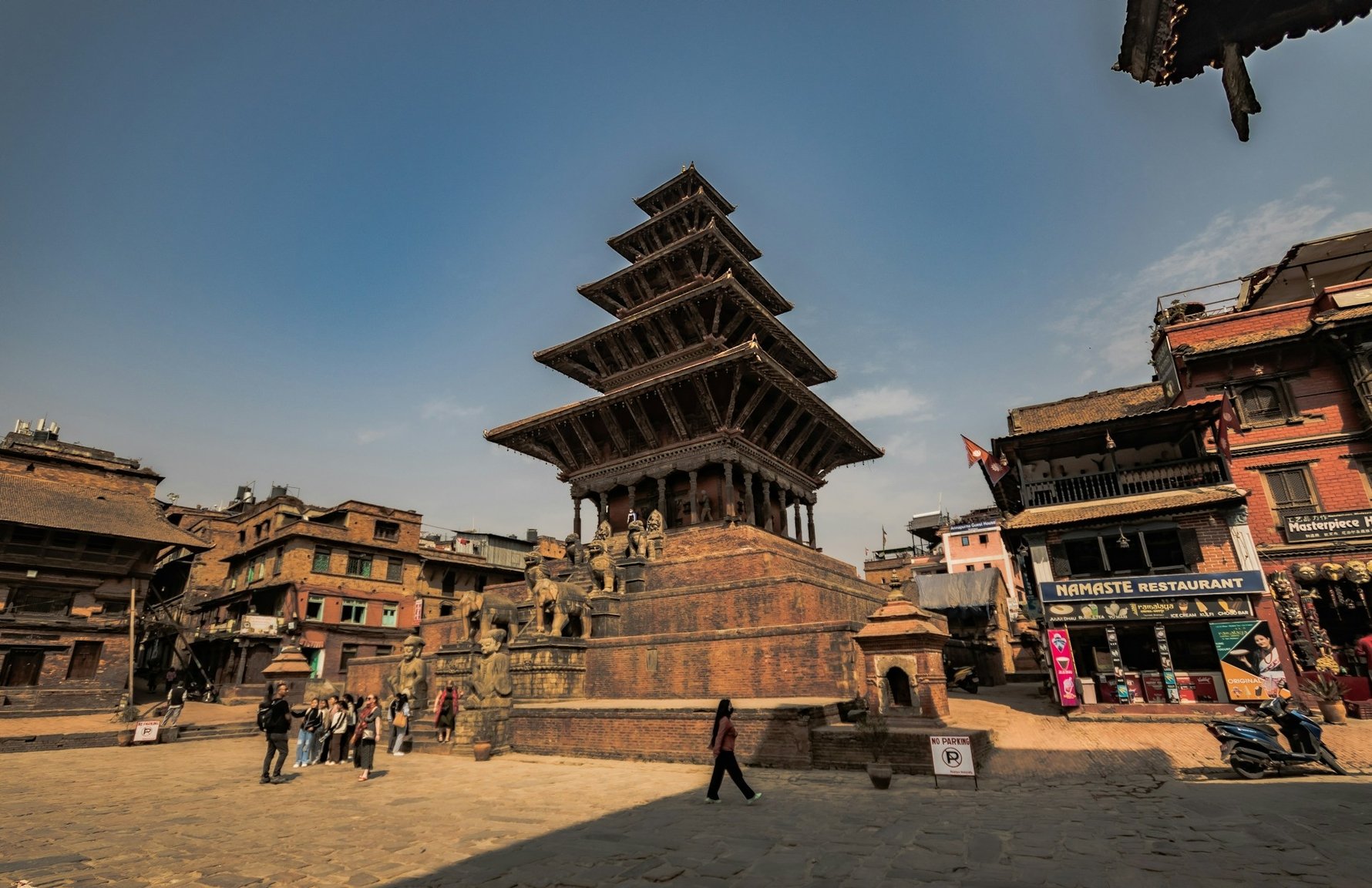
Bhaktapur is the showpiece of the valley, full stop. About 14 kilometres east of Kathmandu, it's a medieval city that has been far more carefully preserved than the capital, with brick-paved streets, a largely car-free historic core, and a townscape that rewards wandering in any direction.
The 55-Window Palace is the centrepiece – a 15th-century royal palace whose carved peacock windows are amongst the finest examples of Newari woodcarving anywhere. The Nyatapola Temple, a five-storey pagoda dating from 1702, dominates the Taumadhi Square just to the east of the main Durbar Square and is one of the tallest traditional structures in Nepal. It survived the earthquake virtually unscathed.
The entry fee for Bhaktapur is higher than the other sites at US$18 (or NPR 1,800) for foreign nationals. This covers the Durbar Square, Taumadhi Square, Dattatreya Square, and the surrounding historic city area – effectively the whole of the old town, and the ticket is valid for multiple visits over several consecutive days. It's worth it. Children under 10 enter free.
While you're in Bhaktapur, try juju dhau (king curd) – a sweet, thick yogurt made only in the city and sold in clay pots. It's one of the better things you'll eat in Nepal.
Kathmandu Durbar Square (Hanuman Dhoka)
The oldest and most historically significant of the three squares, though also the most visibly affected by the 2015 earthquake. A decade on, restoration is well advanced – over 80% of the monuments have been restored or stabilised – but this is the one where you're most likely to encounter active rebuilding work.
Don't let that put you off. The square is vast, historically layered in a way that the others aren't, and still contains several unmissable things.
The Kumari Chowk is the gilded courtyard residence of the Kumari – the living goddess, a young girl selected through an elaborate traditional process to embody the goddess Taleju. She occasionally appears at a carved first-floor window; if you see her, you're lucky, as appearances aren't scheduled. The Kasthamandap – the wooden pavilion that gave Kathmandu its name – was completely destroyed in the earthquake but was painstakingly rebuilt using traditional materials and reopened in 2022. The Kala Bhairab, a ferocious six-armed stone relief of the fearsome form of Shiva, stares down from the north side of the square and is one of the most striking images in the valley.
Entry: NPR 1,000 for foreign nationals (includes the Tribhuvan Museum in the old palace). The square is open all day; the museums are typically closed on Tuesdays.
The Two Stupas
Boudhanath
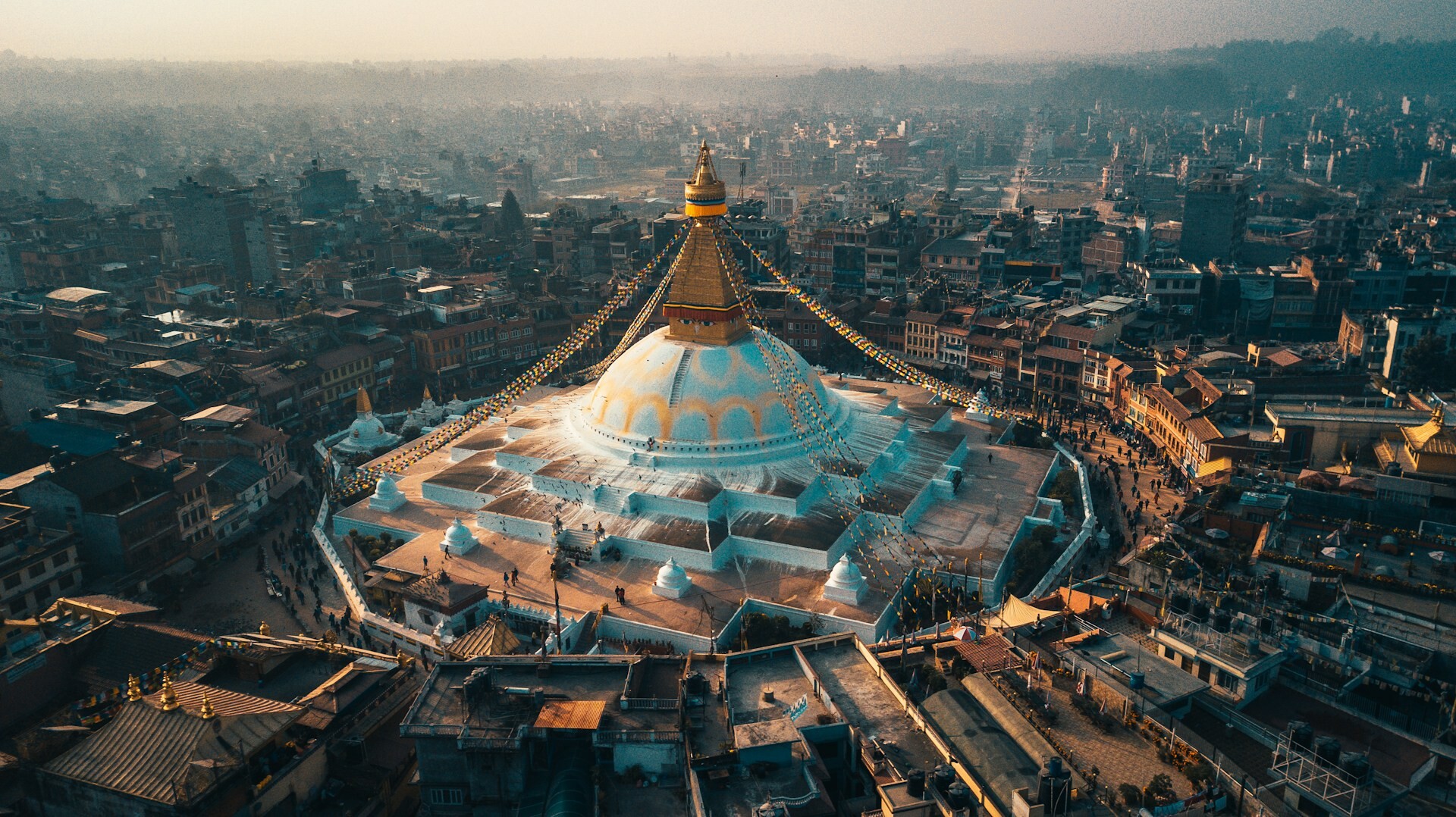
One of the largest Buddhist stupas in the world, and the spiritual heart of Nepal's Tibetan community. Boudhanath sits about 7 kilometres northeast of central Kathmandu, surrounded by a ring of monasteries, Tibetan tea houses, and shops selling thangka paintings, prayer flags, and singing bowls in quantities that would make your living room look like a monastery.
The stupa itself is extraordinary – a vast white dome topped by a gilded tower painted with the watchful eyes of the Buddha, visible from a considerable distance in most directions. Walk the kora (circumambulation circuit) clockwise with pilgrims and monks, spinning the prayer wheels embedded in the outer wall as you go. Do it at dusk if you can, when butter lamps are lit, the crowd thickens, and the light turns golden. It's one of those experiences that is hard to oversell.
The stupa was repaired after 2015 damage remarkably quickly – the central pinnacle and dome were restored by late 2016, ahead of almost every other heritage site in the valley. Entry: NPR 400 for foreign nationals.
Swayambhunath (the Monkey Temple)
Perched on a wooded hill west of Kathmandu, Swayambhunath is one of the oldest Buddhist sites in the valley – some accounts put its origins as far back as the 5th century. The hill rises steeply from the valley floor, and the traditional approach is the eastern staircase: 365 stone steps lined with prayer wheels, smaller shrines, and the temple's resident population of rhesus macaques, who have a long-running policy of treating tourists as a food source and should be approached with the same wary respect you'd give any sentient creature capable of stealing your breakfast.
The stupa at the top is smaller than Boudhanath but arguably more atmospheric – the setting is extraordinary, the views across the valley are wonderful on a clear day, and the mix of Buddhist and Hindu shrines around the main dome reflects the syncretic religious culture of the Newars. Sunrise is a popular time to visit; the light is good and the crowds are manageable. Entry: NPR 200 for foreign nationals. There's a road to the back of the hill if you'd rather not do the steps.
The Two Hindu Temples
Pashupatinath
Nepal's most sacred Hindu temple complex is not a place you visit in the conventional tourist sense. It's an experience that asks something of you – some patience, some sensitivity, and a willingness to witness things you might not see anywhere else in your life.
The temple is dedicated to Lord Shiva in his form as Pashupati, Lord of the Animals, and the complex extends across both banks of the Bagmati River, with dozens of shrines, ashrams, and subsidiary temples connected by ghats (riverside steps). Non-Hindus cannot enter the main temple – you can view it from across the river, and the view of the golden roof and silver-plated doors is impressive enough. What you can access freely is the surrounding complex, and what you cannot avoid seeing, from the eastern bank, is the cremation ghats.
Open-air cremation is carried out here daily, as it has been for centuries, on stone platforms at the water's edge. It is confronting, it is real, and if you approach it with the right frame of mind, it is one of the most profound things you can witness as a traveller. Please maintain a respectful distance and do not photograph grieving families. Entry: NPR 1,000 for foreign nationals. The temple is open from around 4am to 7pm; early morning is the most spiritually alive time to visit, with ritual bathing, prayer, and the devotional aarti ceremony at dawn.
Pashupatinath and Boudhanath are close to each other (about 2 kilometres apart) and close to the airport, making the east side of the city a logical half-day grouping.
Changu Narayan
The oldest of the seven sites and the least visited – which makes it our dark horse recommendation. Changu Narayan sits on a forested ridge about 12 kilometres northeast of Bhaktapur, surrounded by a traditional Newari village of the same name. Getting there requires a little effort: a taxi from Bhaktapur, or a hike up from the valley floor if you're feeling energetic. The reward is a temple complex of genuine antiquity – the earliest inscriptions here date from the 5th century AD, and the stone sculptures scattered around the courtyard are among the finest examples of early Nepali art in existence.
The setting is also peaceful in a way that the city sites, busy with tour groups and touts, simply aren't. Combine it with Bhaktapur for a full day on the east side of the valley. Entry: NPR 300 for foreign nationals.
How to Sequence the Seven Sites
Trying to do all seven in one day is technically possible but deeply inadvisable. You'll end up frazzled, footsore, and remembering nothing except taxi queues. Two days is the minimum for doing justice to the sites. Three is better.
A logical two-day split:
Day 1 – East side: Pashupatinath (early morning), then Boudhanath, then – if you have the energy – take a taxi to Bhaktapur for the afternoon and combine with a visit to Changu Narayan.
Day 2 – West and centre: Swayambhunath at sunrise (or first thing), then Patan Durbar Square (spend the bulk of your time here), then cross back to Kathmandu Durbar Square for the late afternoon light.
If you have a third day, use it for Bhaktapur properly – it deserves a full, unhurried day rather than a rushed afternoon.
Ready to explore beyond the sites? Our day trips from Kathmandu guide covers Nagarkot, Dhulikhel, Panauti, and other escapes within easy reach of the valley.
And if all this temple-hopping has made you want to head for the hills, our trekking in Nepal guide is where to start.