Miami has a reputation problem, in the sense that its reputation precedes it so thoroughly that visitors often arrive with a fully formed mental image of the place: neon, ocean, abs, heat, excess. The reality is more complicated and, frankly, more interesting. The city incorporated in 1896, which makes it young by any reasonable measure, but it has crammed rather a lot into those years: Cuban exiles, Art Deco preservation battles, a warehouse district turned global art destination, and one of the most genuinely strange natural landscapes on earth sitting roughly an hour from downtown. There is more going on here than the postcards suggest.
Admission prices below were accurate at time of writing, though Miami has a well-established habit of revising them upwards. A quick check of official websites before you visit is the sensible precaution.
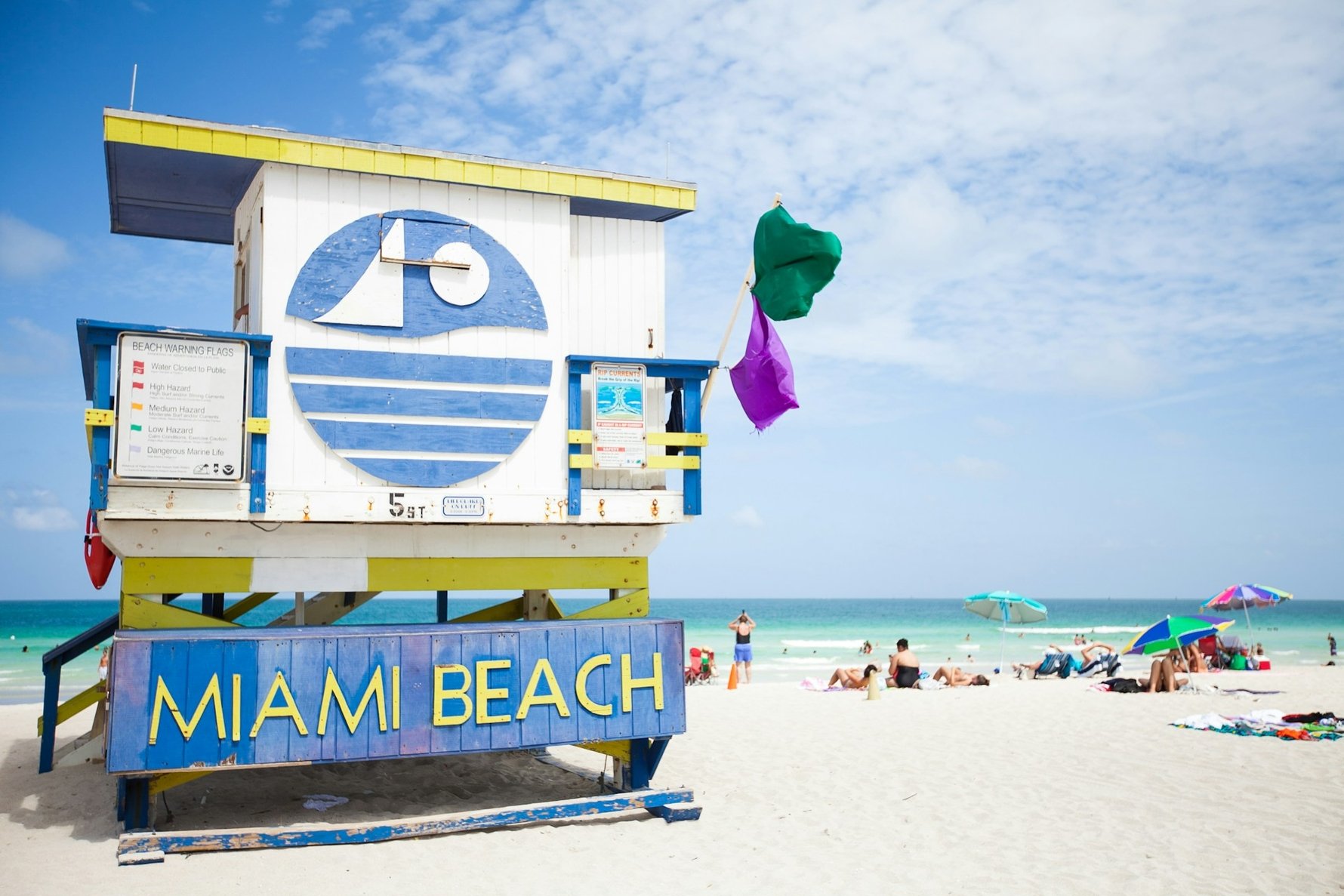
The Art Deco Historic District occupies roughly one square mile of South Beach and contains over 800 buildings constructed between 1923 and 1943, making it the largest concentration of Art Deco architecture in the world. The style arrived here in the aftermath of the 1926 hurricane, which levelled much of the city and created the opportunity to rebuild, and Miami's architects produced their own local variant, “Tropical Deco,” complete with nautical motifs, pastel facades, porthole windows and the “eyebrow” ledges above windows that kept the sun out and the interiors marginally less stifling.
By the 1970s, the buildings had aged into disrepair and developers were circling. The district owes its survival largely to preservationist Barbara Baer Capitman, who co-founded the Miami Design Preservation League and drove the campaign that placed it on the National Register of Historic Places in 1979, at which point several of the buildings were not yet 50 years old. Ocean Drive, Collins Avenue and Washington Avenue are the main stretches; the Miami Design Preservation League runs walking tours out of its Art Deco Welcome Center for anyone who wants more than photographs.
Location: Ocean Drive, Collins Avenue and Washington Avenue, South Beach, Miami Beach, FL 33139
Best time to visit: Early morning, when the light is good and the previous evening’s crowd has not yet reconvened. The district is technically best appreciated on foot in any direction.
Ticket prices: The district itself is free to walk. MDPL walking tours run around $35, with reduced rates for seniors, students and veterans.
Good to know: The Wolfsonian–FIU, just off Washington Avenue, holds a significant collection of design and propaganda art from the same period as the buildings outside. A natural pairing if the architecture has done its job.
2. Vizcaya Museum and Gardens
James Deering, vice-president of the International Harvester Company and a man who had clearly given serious thought to how he wanted to spend his winters, broke ground on Vizcaya in 1914 and first occupied it on Christmas Day 1916. The result was a 34-room Italian Renaissance villa on the shores of Biscayne Bay, furnished with European decorative arts dating from the 15th to the 19th centuries, many of them acquired room by room from actual European palaces and reassembled in South Florida. Deering lived there nine winters and died in 1925. His nieces eventually sold the estate to Miami-Dade County in 1952 for $1 million, which, given what they got, was generous of them.
Vizcaya has appeared in Ace Ventura: Pet Detective, Bad Boys II and Iron Man 3, which tells you something about its range. The ten acres of formal gardens, designed by landscape architect Diego Suárez, extend behind the main house toward a native hardwood hammock and a mangrove shoreline, while the house itself faces Biscayne Bay from a broad terrace that Deering specifically wanted approached from the water. It was designated a National Historic Landmark in 1994.
Location: 3251 S. Miami Avenue, Miami, FL 33129 (Coconut Grove)
Best time to visit: Weekday mornings. The gardens are particularly good in the cooler months between November and March.
Ticket prices: Check vizcaya.org for current prices, as these have shifted over time.
Good to know: The estate sits in Coconut Grove, which makes it a natural pairing with a wander through Miami’s oldest neighbourhood. Budget a minimum of two hours; the gardens alone justify the trip.
3. Little Havana and Calle Ocho
After Fidel Castro’s revolution of 1959, Cuban exiles settled in a former Jewish neighbourhood west of downtown and, within a decade, had transformed it into the most concentrated stretch of Cuban culture in the United States. By the 1970s, Little Havana was over 85% Cuban; in 2017, the National Trust for Historic Preservation declared it a National Treasure, which is presumably some consolation for the ongoing gentrification.
The neighbourhood’s main artery is Calle Ocho, SW 8th Street, where the smell of Café Cubano and cigar smoke is not an ambient affectation but the actual smell of the street. Máximo Gómez Park, known as Domino Park, is where older residents have gathered to play dominoes and conduct vigorous political debate for decades; the Tower Theater dates to 1926; the Walk of Stars honours Cuban musicians and cultural figures. The annual Calle Ocho Festival, held in March as part of Carnaval Miami, closes twenty or so blocks and draws crowds in the hundreds of thousands. The neighbourhood has evolved: Nicaraguans, Colombians and other Latin American communities have added their own layers. But the Cuban imprint is structural, and the coffee is non-negotiable.
Location: Centred on SW 8th Street between 12th and 27th Avenues, Miami, FL 33135
Best time to visit: Any time, though the neighbourhood is most alive in the evening. The Calle Ocho Festival takes place in March.
Ticket prices: Free to explore. Individual venues and restaurants vary.
Good to know: HistoryMiami Museum runs walking tours of Little Havana with historical context that a solo wander would miss. The Cubaocho Museum and Performing Arts Center is worth an evening for live music and a mojito.
4. Wynwood Walls
Wynwood was a warehouse district from the 1920s and, by the early 2000s, was not much else. Real estate developer Tony Goldman, who had previously been responsible for reviving South Beach, acquired a series of large, blank-walled storage facilities in 2009 and commissioned murals from street artists across the world. The Wynwood Walls now covers over 80,000 square feet of painted surface by artists from sixteen countries, including Shepard Fairey and Os Gemeos, across half a dozen former warehouses in the heart of the Wynwood Arts District.
Goldman died in 2012, before he could witness what happened next: the surrounding neighbourhood followed the art, as it invariably does, and Wynwood is now among the more thoroughly transformed urban districts in the country, with galleries, breweries, restaurants and the kind of bars that have named cocktails served by people with very considered facial hair. Whether this is a triumph or a cautionary tale depends largely on whether you were there before 2009. As it stands, Wynwood Walls is genuinely worth seeing, and the street art extends well beyond the main compound into the surrounding blocks.
Location: 2520 NW 2nd Ave, Miami, FL 33127
Best time to visit: Weekday mornings for the murals; weekend evenings if you want the neighbourhood at full volume. The monthly “Second Saturdays” gallery walk covers the wider art district.
Ticket prices: The outdoor walls and surrounding streets are free. Some installations and events within the compound charge admission.
Good to know: The Museum of Graffiti is a short walk away and provides useful context on the history of the art form, if the walls have raised questions you want answered.
5. Pérez Art Museum Miami (PAMM)
Founded in 1984 as the Center for the Fine Arts, renamed, relocated and comprehensively reimagined, the Pérez Art Museum Miami opened in its current form in December 2013 in a building designed by Pritzker Prize-winning Swiss firm Herzog & de Meuron. The structure sits in Maurice A. Ferré Park on Biscayne Bay, its hanging gardens designed by botanist Patrick Blanc spilling from the façade, with views across the water toward Miami Beach. It is, as buildings designed to house art go, fairly comfortable with the competition.
The collection focuses on 20th and 21st-century international art, with particular emphasis on work from the Americas, the Caribbean and the African diaspora, which reflects the city it sits in rather than simply following default museum logic. The permanent collection is supplemented by rotating exhibitions that tend toward the politically engaged end of contemporary practice. The on-site restaurant, Verde, is genuinely good by museum-restaurant standards.
Location: 1103 Biscayne Blvd, Miami, FL 33132 (Museum Park, Downtown)
Best time to visit: Thursday evenings, when the museum stays open until 9pm. Closed Tuesdays and Wednesdays.
Ticket prices: Around $18 for adults; reduced rates for students, seniors and children. Free for under-7s. Check pamm.org for current prices.
Good to know: The Phillip and Patricia Frost Museum of Science is immediately adjacent, making the two an efficient pairing for a full day in Museum Park. The Metromover’s Museum Park station is a short walk away and is free to use.
6. Everglades National Park
Most national parks have their main selling points visible from the car park. The Everglades requires slightly more effort, being a 1.5-million-acre subtropical wetland ecosystem in which the spectacle is distributed rather than concentrated, and frequently submerged. Established in 1947 after decades of drainage attempts that nearly destroyed it, the park is a UNESCO World Heritage Site, an International Biosphere Reserve and one of the genuinely irreplaceable places on the American continent. It is also, practically speaking, about an hour’s drive from downtown Miami.
The main entrance at Ernest F. Coe Visitor Center provides access to walking trails, a tram route through the sawgrass prairies and the Anhinga Trail, which offers an almost unreasonably close encounter with wading birds, alligators and the general theatre of a functioning ecosystem. Airboat tours operate from private concessions on the northern edge of the park, offering a faster and noisier version of the same landscape. The Shark Valley section, accessed from a separate entrance on US-41, has a 15-mile loop and an observation tower. Alligators are extremely common and entirely unconcerned by visitors, which is either reassuring or alarming depending on your prior expectations.
Location: Main entrance at 40001 State Road 9336, Homestead, FL 33034; approximately one hour from downtown Miami by car.
Best time to visit: November to April (dry season), when wildlife concentrates around shrinking water sources and the mosquitoes are less committed. Visiting in summer is possible; bring repellent.
Ticket prices: Park entry around $35 per vehicle; valid for seven days. Airboat tours from private operators outside the park are priced separately.
Good to know: The park has no food facilities beyond the visitor centres. If you intend to stay all day, plan accordingly. Sunscreen is not optional.
7. Coconut Grove
Miami was incorporated in 1896. Coconut Grove was established in 1873. The locals have not forgotten this, and some of them are still cross about the 1925 annexation that folded the Grove into Miami in a referendum that 87% of Coconut Grove residents voted against. The State of Florida allows residents to list Coconut Grove rather than Miami on their driving licences, which says something about the depth of feeling.
The neighbourhood is the oldest continuously inhabited settlement in South Florida, with Bahamian roots dating to the 1870s and a roster of famous past residents that runs from Alexander Graham Bell and Tennessee Williams to Jimmy Buffett and Madonna. The Barnacle Historic State Park contains the oldest house in Miami-Dade County still standing in its original location: a two-storey wooden structure built in 1891 by yacht designer Commodore Ralph Middleton Munroe. The surrounding streets are shaded by banyan trees; peacocks roam the area with the confidence of a species that has worked out no one is going to stop them. The bayside parks and the Dinner Key Marina give the Grove its character, which is unhurried in a way that feels genuinely alien by Miami standards.
Location: Approximately 5km south of Downtown Miami, centred on Main Highway and Grand Avenue.
Best time to visit: Any time. The farmers market at Glaser Farms runs on Saturdays. The Barnacle is best visited on a weekday when the park is quiet.
Ticket prices: Free to walk. The Barnacle Historic State Park charges a small entry fee.
Good to know: Vizcaya is a short walk from the Grove’s northern edge, making the two a natural pairing.
8. HistoryMiami Museum
The question of whether Miami has any history is one that Miami itself finds irritating, and the HistoryMiami Museum exists partly as a rebuttal. Founded in 1940 (as the Historical Museum of Southern Florida), it is now the largest history museum in Florida, a Smithsonian affiliate, and home to over a million historic images, 30,000 three-dimensional artefacts and a collection that runs from prehistoric archaeological finds through gold and silver recovered from Spanish shipwrecks to 20th-century Afro-Cuban folk art.
The permanent exhibition “Miami: The Magic City” traces the city’s development from early settlement to the present, including the parts that the tourism board might prefer to gloss over. The museum does not shy away from the complicated history of a city built on drained land, shaped by displacement and defined by successive waves of migration. The South Florida Folklife Centre covers Cuban cigar-rolling, Brazilian samba and the quinceañera with equal seriousness. It is a good museum in a city that assumes people came for other things.
Location: 101 W Flagler St, Miami, FL 33130 (Miami-Dade Cultural Center, Downtown)
Best time to visit: Weekday mornings, when the galleries are quiet enough to be properly absorbed.
Ticket prices: Check historymiami.org for current admission fees.
Good to know: The museum runs city tours, including a Little Havana history walk and a monthly evening boat tour of the Miami River, which are worth booking separately.
9. Phillip and Patricia Frost Museum of Science
The Frost Museum of Science opened in 2017 in Museum Park, immediately west of PAMM, and sits among a very small number of institutions worldwide to combine a full aquarium and a full planetarium under the same roof. This is either extremely convenient or a sign that Miami cannot make up its mind, but in practice the combination works well: the aquarium occupies several floors of the north and west wings, with a three-story cylindrical tank called the “Oculus” at its centre, while the planetarium sits at the top of the structure and runs a programme of dome shows.
Six floors of interactive exhibitions cover the Everglades ecosystem in considerable depth, which is useful context if the national park is also on the itinerary. The museum pitches itself as family-friendly, which it is, without condescending to visitors who are not children. The location, with views across Biscayne Bay and a short walk from the PAMM, makes it easy to pair with its neighbour.
Location: 1101 Biscayne Blvd, Miami, FL 33132 (Museum Park, Downtown)
Best time to visit: Weekday mornings for the smallest crowds. Planetarium shows run throughout the day; check the schedule in advance.
Ticket prices: Check frostscience.org for current prices; combination tickets with planetarium shows are available.
Good to know: The Metromover Museum Park station serves both the Frost and PAMM. A combined visit to both museums is a full day comfortably spent.
10. Brickell
In the 1920s, Brickell Avenue was known as Millionaire’s Row, lined with the winter estates of Gilded Age industrialists who wanted waterfront property in a warm place and had the resources to build it properly. By the 1950s, most of the mansions had been demolished for apartment buildings. By the 1980s, the neighbourhood had become Miami’s financial district. Today it is one of the fastest-growing urban neighbourhoods in the United States, a vertical city of glass towers whose ground-level streets contain more cranes than the average visitor expects to see in a place this polished.
Brickell is not a museum, but it is interesting in the way that a city revealing itself in real time tends to be interesting. The waterfront along Brickell Key and the Riverwalk provide a ground-level perspective on the skyline that the towers themselves obscure. The neighbourhood’s relative youth means it lacks the layered history of the Grove or the cultural weight of Little Havana, but it is undeniably Miami’s present tense, and the walk along the bay at any hour of the day confirms that the city’s instinct for the spectacular has not been interrupted by the passage of time.
Location: South of Downtown Miami, centred on Brickell Avenue between the Miami River and SW 26th Road.
Best time to visit: Evening, when the office population clears and the waterfront bars operate properly. The Riverwalk is particularly good at dusk.
Ticket prices: Free.
Good to know: The free Metromover circulates through Brickell and Downtown, which removes the parking problem entirely and lets you approach the neighbourhood from above before descending into it.
What else can you see in Miami?
The Freedom Tower, on Biscayne Boulevard, is a 1925 Mediterranean Revival building that served as the processing centre for Cuban refugees arriving in Miami from 1962 onwards, acquiring its nickname “the Ellis Island of the South” in the process. It is now a cultural centre and gallery space owned by Miami Dade College, and one of the few buildings in downtown Miami old enough to carry genuine historical weight.
Fairchild Tropical Botanic Garden, in Coral Gables, covers 83 acres of palms, cycads, flowering trees and rare tropical plants, and provides a genuinely calming contrast to the city’s general momentum. The Design District, north of Wynwood, functions as an outdoor museum of architecture and public art around its luxury retail core, and the rotating installations on the Museum Garage alone are worth the walk. For a day on the water, Biscayne National Park – 95% of which is underwater – offers snorkelling, kayaking and glass-bottom boat tours of the Florida Reef, the only living coral barrier reef in the continental United States, accessible by boat from the park’s mainland visitor centre at Convoy Point.
Miami’s food culture is a serious argument for staying longer. Calle Ocho is the obvious starting point for Cuban food, but the broader Latin American representation across the city is extensive: Haitian, Nicaraguan, Colombian, Brazilian and Venezuelan kitchens operate at every price point. The city is also, in case a reminder were needed, approximately twenty minutes from some of the better beaches on the Atlantic coast.