Glasgow was, by the mid-19th century, the second city of the British Empire and the workshop of the world, producing ships, locomotives, textiles and engineering on a scale that made it simultaneously vast, wealthy and deeply unequal. The wealth funded some extraordinary public architecture and civic institutions; the inequality produced a working-class culture of considerable richness and a political tradition that put a left-wing firebrand on a traffic cone. The city has spent the past forty years recovering from deindustrialisation with more energy and less self-pity than most comparable cities, and the cultural confidence that came from being European City of Culture in 1990 has not really dissipated since. It has the best museums in Scotland, a stronger restaurant scene than Edinburgh, and a population that will talk to you on public transport. Prices below were correct at time of writing; always verify before visiting.
The Kelvingrove Art Gallery and Museum opened in 1902 as part of the Glasgow International Exhibition, funded partly by the proceeds of the 1888 exhibition, and has been the civic museum that Glasgow points to with justified pride ever since. The building – a Spanish Baroque extravaganza in red sandstone, with towers, turrets and a grand entrance that faces into Kelvingrove Park rather than the street, which has prompted an entirely fictitious story about the architect jumping from the tower in despair when he realised his mistake – is one of the finest Victorian public buildings in Scotland. The 22 galleries inside hold over 8,000 objects across natural history, arms and armour, Egyptian antiquities, Scottish history and one of the great civic art collections in Europe.
The art collection covers the French Impressionists (Monet, Renoir, Pissarro), Old Masters (Rembrandt’s Man in Armour, a Titian), the Scottish Colourists and the Glasgow Boys, and – in a room of its own, lit to replicate the painting’s internal light – Salvador Dalí’s Christ of Saint John of the Cross (1951), purchased for £8,200 in 1952. The Spanish government has since offered £80 million for its return. The natural history section features Sir Roger, an Asian elephant who arrived at the museum in 1900, and a Supermarine Spitfire suspended from the ceiling of the main hall. Daily organ recitals take place at 1pm on weekdays and 3pm at weekends. It is the most visited free attraction in Scotland and the most visited museum in the UK outside London.
Location: Argyle Street, Glasgow G3 8AG (West End, Kelvingrove Park). A 20-minute walk from the city centre or subway to Kelvinhall.
Best time to visit: Weekday mornings for smaller crowds. The organ recitals are worth planning around.
Ticket prices: Free for the permanent collection. Check glasgowlife.org.uk for temporary exhibitions and current opening hours.
Good to know: Since September 2025, some galleries have been affected by ongoing restoration works funded by Glasgow City Council. Verify access to specific galleries before visiting if there is a particular object you want to see.
2. Glasgow Cathedral and the Necropolis
Glasgow Cathedral is the oldest building in Glasgow and the only medieval cathedral on the Scottish mainland to survive the Reformation substantially intact – its companion, St Magnus Cathedral in Orkney, also made it through. That it did so is largely a matter of civic stubbornness: local tradesmen reportedly far outnumbered the iconoclasts who came to destroy it in 1560 and saw them off. The result is a 13th-century Gothic building of considerable atmosphere, built over the tomb of St Mungo, the patron saint of Glasgow, in whose honour the city’s coat of arms encodes a robin, a tree, a bell and a fish – each a reference to one of his miracles, and all of them commemorated in the city’s unofficial motto: “Here is the bird that never flew, here is the tree that never grew, here is the bell that never rang, here is the fish that never swam.” The Lower Church, where Mungo’s tomb lies, is the finest Romanesque space in Scotland.
Immediately behind the cathedral, across the Bridge of Sighs, the Glasgow Necropolis climbs a steep hill in 37 acres of Victorian funerary ambition. Modelled on Père Lachaise in Paris and opened in 1833, it holds around 50,000 burials and 3,500 monuments, from the towering column of John Knox at the summit (looking down on the cathedral he did not destroy) to a Charles Rennie Mackintosh-designed Celtic cross tucked among the lower slopes. The first person buried here was a Jewish jeweller named Joseph Levi, a full year before the first Christian burial, which suggests the Necropolis’s commitment to its interdenominational remit was genuine rather than merely stated.
Location: Cathedral Square, Glasgow G4 0QZ. A 20-minute walk from the city centre or bus to Cathedral Square. Necropolis entrance via the Bridge of Sighs behind the cathedral.
Best time to visit: The cathedral is quietest on weekday mornings. The Necropolis is free to enter at all times and particularly atmospheric in low light.
Good to know: Guided tours of the Necropolis are run by the Friends of Glasgow Necropolis; see glasgownecropolis.org for dates. Provand’s Lordship, the oldest house in Glasgow (1471), is immediately opposite the cathedral and worth a brief stop.
3. The Burrell Collection
Sir William Burrell was a Glasgow shipping magnate who sold his entire fleet in 1916 at enormous profit, retired in his late fifties, and spent the rest of his very long life – he died in 1958 at 96 – buying art. He started at 15 with a few shillings intended for a cricket bat, and by the time he gave his collection to the city of Glasgow in 1944 it ran to 6,000 objects; he continued adding to it until his death, leaving a collection of over 9,000 items described at the time as “one of the greatest gifts ever made to any city in the world”. The collection is deliberately eclectic: medieval European tapestries and stained glass, Chinese dynastic ceramics, Islamic art, Egyptian antiquities, Persian carpets, Impressionist paintings by Degas and Cézanne, medieval armour, ancient Greek and Roman pieces, and the Hutton Castle rooms reproducing Burrell’s actual home.
The purpose-built museum in Pollok Country Park opened in 1983, closed in 2016 for a major renovation, and reopened in March 2022 after a £68.25 million refurbishment that won the Art Fund Museum of the Year award in 2023 – the only non-national museum ever to receive it. The building, designed in the 1970s by Barry Gasson, uses the surrounding woodland as an active element of the interior experience; trees are visible through the full-height glazing as a continuous backdrop to the medieval stained glass. It is a 20-minute journey from the city centre but well worth the trip.
Location: Pollok Country Park, 2060 Pollokshaws Road, Glasgow G43 1AT. Train from Glasgow Central to Pollokshaws West (10 minutes), then 10-minute walk; or bus 57 from the city centre.
Best time to visit: Weekday afternoons. The park itself is free to walk at any time and is one of the best green spaces in Glasgow.
Ticket prices: Free. Check burrellcollection.com for opening hours and any temporary exhibition charges.
Good to know: Pollok House, the Georgian country house at the other end of the park, is covered separately below and makes a natural companion visit. Both can be covered in a single half-day.
4. Pollok House
Pollok House is at the western end of Pollok Country Park, a ten-minute walk from the Burrell Collection, and is one of the most rewarding and least crowded country house visits in Scotland. The house was built between 1747 and 1752 for the Maxwell family, who had owned the estate since the 13th century, and was extended in the early 20th century by Rowand Anderson. The Maxwells gave the house and its 361-acre park to Glasgow City Council in 1966, and it is now managed by the National Trust for Scotland. The interior retains the feel of a house that has been lived in rather than preserved under glass: comfortable, slightly worn, pleasantly unscreened.
The art collection is the main reason to visit. Sir William Stirling Maxwell, the 9th Baronet, was a collector of extraordinary range and quality, and his Spanish painting collection – including works by El Greco, Goya, Murillo and Zurbarán – is one of the finest in Britain outside the national collections. Goya’s equestrian portrait and the collection of smaller Goya works are particularly strong. The collection is displayed throughout the house in its original arrangement, which gives the visit a quality that purpose-built gallery spaces rarely achieve. The servant quarters below stairs, the butler’s pantry, the kitchen and the wine cellars are also accessible and provide an unusually complete account of a working country house.
Location: Pollok Country Park, Glasgow G43 1AT. Same access as the Burrell Collection; the walk between the two through the park takes around 15 minutes.
Best time to visit: Midweek. The house is rarely busy and rewards a slow visit.
Ticket prices: Around £12 for non-NTS members; free for NTS and National Trust members. Check nts.org.uk/visit/places/pollok-house for current prices and seasonal hours.
Good to know: The Burrell Collection and Pollok House combined, with a walk through Pollok Country Park between them, is the best single day out available in Glasgow.
5. Riverside Museum
The Riverside Museum opened in 2011 on the former site of the A. & J. Inglis shipyard at the confluence of the Kelvin and the Clyde, and the building – designed by Zaha Hadid Architects as a zinc-clad zigzag of peaks and valleys that flows from city to waterfront – was the first major public cultural building Hadid completed in the United Kingdom. It won the European Museum of the Year Award in 2013. The collection, over 3,000 objects, traces the history of transport in Glasgow and Scotland from the earliest bicycles to full-scale locomotives and subway cars, with particular attention to the city’s shipbuilding history through an exceptional collection of ship models that captures the Clyde yards at their peak.
The interior centrepiece is a recreated Glasgow street of around 1900, running down the middle of the museum’s main hall: tenement interiors, shop fronts, a pub, a subway station and a barbershop, all populated with mannequins going about period business. It is an old museum technique that Glasgow executes with unusual commitment and detail. Moored outside, the Tall Ship Glenlee, a three-masted barque built on the Clyde in 1896, is separately ticketed and accessible from the museum quay.
Location: 100 Pointhouse Place, Glasgow G3 8RS. Bus 100 from the city centre; Partick subway or rail station (10-minute walk).
Best time to visit: Weekday mornings. The building is worth admiring from the outside in any weather.
Good to know: The new Govan-Partick pedestrian and cycle bridge, opened in 2024, crosses the Clyde from the museum to Govan, making a natural extension of the visit into one of Glasgow’s most historically interesting neighbourhoods.
6. Gallery of Modern Art
The Gallery of Modern Art (GoMA) occupies a neoclassical building in Royal Exchange Square that was originally built in 1778 as the townhouse of William Cunninghame, a tobacco lord who made a substantial portion of his fortune from the transatlantic slave trade. It became the Royal Exchange in 1829 and Glasgow’s gallery of contemporary art in 1996, and is now the second most visited contemporary art gallery in the UK outside London. The permanent collection focuses on post-1945 work by Scottish and international artists, with a changing programme of temporary exhibitions that tends toward the politically engaged and formally adventurous.
The building is, however, internationally recognised for something that the gallery did not commission and cannot officially endorse. The equestrian statue of the Duke of Wellington by the Italian sculptor Carlo Marochetti, placed in front of the building in 1844, has been wearing a traffic cone on his head for most of the past forty years. The tradition is believed to have started in the 1980s and has defied every attempt at suppression. When Glasgow City Council proposed raising the plinth in 2013 to deter cone-placers – at an estimated cost of £65,000 – a public outcry and a Facebook campaign called “Keep the Cone” forced the withdrawal of the plans. The cone stays. Banksy cited the statue as his favourite work of art in the UK and the deciding factor in bringing an exhibition to Glasgow in 2023.
Location: Royal Exchange Square, Glasgow G1 3AH (city centre, off Buchanan Street). A five-minute walk from Queen Street and Central stations.
Best time to visit: Any time. GoMA is a useful city-centre anchor for a morning before heading to the West End.
Good to know: The library inside the building offers free internet access and is one of the quieter spaces available in central Glasgow on a busy day. The cone on the statue is not the gallery’s property or responsibility; it is placed by passing Glaswegians, usually late at night, and its continued presence is a matter of civic identity.
7. The West End and Byres Road
The West End of Glasgow is the university neighbourhood, and it shows. The main campus of the University of Glasgow occupies a Gothic Revival building by George Gilbert Scott completed in 1870 on Gilmorehill, with views south over the Kelvin and north toward the Campsie Fells, and the surrounding streets of Victorian terraced houses have been colonised by the kind of independent bookshops, record shops, delicatessens, coffee bars and restaurants that tend to cluster around universities with serious academic departments. Byres Road is the main artery – a mile of independent and small-chain retail running from the top of Dumbarton Road to Great Western Road – and the lanes and closes off it, particularly Ashton Lane, contain some of the best eating and drinking in the city.
The Botanic Gardens, at the northern end of Byres Road, provide 27 acres of formal and informal planting with the Kibble Palace at their centre – a large wrought-iron and glass curvilinear glasshouse of 1873 that was floated up the Clyde from its original location at a private estate in Coulport and reassembled in the gardens. The main range glasshouse next to it contains tropical and economic plant collections. Both are free. The surrounding streets – Great Western Road with its long Georgian terraces, Hyndland, Dowanhill – extend the quality of the neighbourhood considerably beyond the main commercial strip.
Location: Byres Road runs between Dumbarton Road and Great Western Road; subway to Hillhead is the easiest access. Botanic Gardens entrance on Great Western Road, Glasgow G12 0UE.
Best time to visit: Any time. Saturday morning for the farmers’ market in the car park of Waitrose on Byres Road. Ashton Lane is best in the evening.
Ticket prices: Free. Check glasgowbotanicgardens.com for Kibble Palace and glasshouse opening hours.
Good to know: The Hunterian Museum and Art Gallery, part of the University of Glasgow, holds a significant archaeological and fine art collection including the largest collection of work by J.A.M. Whistler outside the United States, and is free. Check gla.ac.uk/hunterian for opening hours.
8. Glasgow Green and the People’s Palace
Glasgow Green was gifted to the people of Glasgow by the Bishop of Glasgow in 1450, making it one of the oldest public parks in Britain, and it has been a civic commons – for washing, bleaching, grazing, recreation and protest – ever since. James Watt is said to have had the idea for the separate condenser for the steam engine while walking across it in 1765. The Calton Weavers were shot dead on it in 1787 during a strike. The Chartists met on it. The suffragettes met on it. Nelson’s monument was raised on it in 1806, predating the one in London’s Trafalgar Square by thirty-seven years, which is a detail that Glasgow considers important and London has not yet acknowledged. The Doulton Fountain, restored and standing at the park’s eastern end, is the largest terracotta fountain in the world at 14 metres high.
The People’s Palace, the social history museum opened in 1898 to serve Glasgow’s East End working population, and its extraordinary adjoining Winter Gardens glasshouse, are both currently closed for major refurbishment and are not due to reopen until 2027. The closure is regrettable; the institution, when open, is one of the most honest and affectionate civic social history museums in Britain. The park itself, the fountain, the Templeton’s Carpet Factory building – a Venetian Gothic extravagance built in 1889 in deliberate imitation of the Doge’s Palace to appease its residential neighbours – and the river frontage are all worth visiting regardless.
Location: Glasgow Green, G40. A 20-minute walk east of the city centre along the Clyde, or bus to the Saltmarket.
Best time to visit: Daytime. TRNSMT music festival occupies the Green in summer; the World Pipe Band Championships in August are worth timing a visit around.
Good to know: The Barrowland Ballroom, immediately north of the Green on Gallowgate, is one of the finest live music venues in Britain and appears on the Good to Know of the Barras entry below. The Barras market is a short walk from the Green and makes a natural pairing.
9. The Barras
The Barras is a weekend market in the East End of Glasgow that has been operating continuously since the 1920s, when Margaret McIver began renting barrows to street traders and gradually acquired the surrounding yards and covered halls. It occupies a network of streets and covered arcades between the Gallowgate and London Road, east of the city centre, and on Saturday and Sunday mornings it hosts upward of a thousand stalls selling antiques, second-hand goods, clothing, electronics, food, tools, toys, records and an assortment of other objects whose provenance is not always straightforwardly established. It is chaotic, noisy, occasionally baffling and entirely genuine, and it has nothing in common with the curated market experiences that most European cities now offer instead.
The surrounding area has its own points of interest. The Barrowland Ballroom, on Gallowgate just north of the market, is a 1930s dancehall with a neon sign that has become one of Glasgow’s most recognisable images and a music venue of considerable reputation; the sloped floor, the sprung dancefloor and the low ceiling combine to produce an acoustic and atmosphere that touring musicians consistently cite as among their favourites anywhere. The Merchant City, the former warehouse district immediately west of the Barras, was regenerated in the 1980s and provides a contrasting streetscape of converted Victorian warehouses, bars and restaurants.
Location: Gallowgate / London Road, Glasgow G1. A 15-minute walk east of the city centre, or bus along Gallowgate. Open Saturday and Sunday only.
Best time to visit: Saturday morning, from around 9am, when the stalls are setting up and before the crowds build. Sunday is quieter.
Ticket prices: Free to enter. See thebarras.com for information on the Barrowland Ballroom programme.
Good to know: The Barras closes early afternoon; arriving late on a Sunday will find most stalls already packing up. The covered market halls are worth exploring beyond the main Gallowgate frontage.
10. The Clyde Waterfront
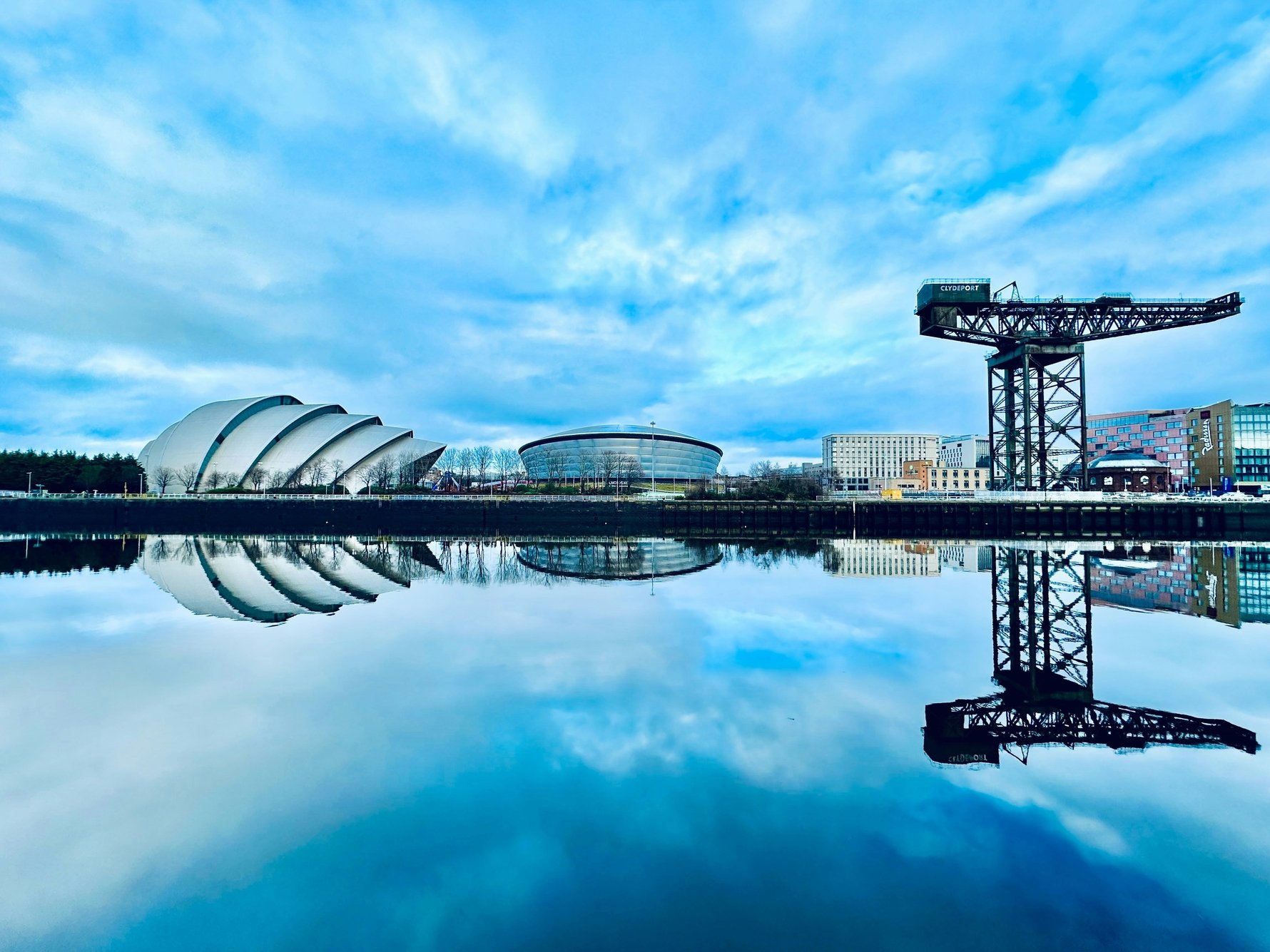
The Clyde Waterfront is the former industrial docklands running west from Glasgow city centre to the Riverside Museum, and the regeneration of this area over the past thirty years constitutes one of the more thoroughgoing urban transformations in Britain. The shipyards, drydocks and warehouses that made Glasgow one of the world’s great industrial cities are gone; what remains is a mixture of residential towers, cultural venues, conference facilities and the occasional preserved relic of the city’s maritime past. The walk along the north bank from the Broomielaw to the Riverside Museum, roughly 3 kilometres, passes the Tradeston Bridge (“squiggly bridge”), the Finnieston Crane – a 175-foot cantilever crane preserved as an industrial monument and now a symbol of the city – and the cluster of venues around the Scottish Event Campus: the SSE Hydro, the Armadillo (formally the Clyde Auditorium, designed by Norman Foster) and the conference centre itself.
The south bank of the Clyde, accessible via the pedestrian bridges and the new Govan-Partick bridge, offers a different perspective and connects the waterfront walk to the Riverside Museum and Govan, one of Glasgow’s most historically layered and architecturally interesting communities. The Govan Old Parish Church, with its collection of early medieval Pictish stones – the Govan Stones, among the most significant early medieval sculptural collections in Scotland – is a few minutes’ walk from the south end of the Govan-Partick bridge and is a significant and largely unvisited cultural treasure.
Location: The Broomielaw, Glasgow city centre, running west to Pointhouse (Riverside Museum). Partick subway or rail station for the western end.
Best time to visit: Any time; the walk is good in any weather. The Finnieston Crane and the SSE Hydro are illuminated at night.
Ticket prices: Free to walk. Govan Old Parish Church admission by donation; check govanold.org.uk for opening hours and the Govan Stones visitor information.
Good to know: The area around Finnieston on the north bank – particularly Argyle Street between the Kelvingrove and the SECC – has become one of the densest concentrations of restaurants and bars in Glasgow over the past decade, and is the place to eat if you are visiting the Riverside Museum or the West End.
What else is there to see in Glasgow?
Several strong entries narrowly missed the list. The Hunterian Museum and Art Gallery at the University of Glasgow holds Scotland’s oldest public museum collection, a significant art collection including the world’s largest holding of Whistler’s work, and the only reconstruction of Charles Rennie Mackintosh’s own house interior; it is free and consistently undervisited. The Tenement House, a National Trust for Scotland property on Buccleuch Street in Garnethill, is a first-floor flat preserved exactly as it was when its occupant, a shorthand typist named Agnes Toward, moved out in 1965 after 50 years of residence, and it provides a more precise and affecting account of Glasgow working-class domestic life than any purpose-built museum could. The St Mungo Museum of Religious Life and Art, adjacent to Glasgow Cathedral, holds the only permanent collection of art exploring world religions in the United Kingdom and is free.
Glasgow eats very well by any reasonable standard. The concentration of independent restaurants in Finnieston, the West End and the Merchant City, added to a well-developed cafe culture, means the city’s reputation for fried food is approximately thirty years out of date. The whisky selection in any serious Glasgow bar is extraordinary. For day trips, Loch Lomond is 45 minutes north by train to Balloch, and the Trossachs an hour beyond that. Inveraray, the most complete Georgian planned town in Scotland, is 90 minutes west on the Loch Fyne shore; the ferry from Gourock to Dunoon opens the Cowal Peninsula in 20 minutes. The main difficulty in using Glasgow as a base for day trips is the variety of options rather than the scarcity.