A little bit of history
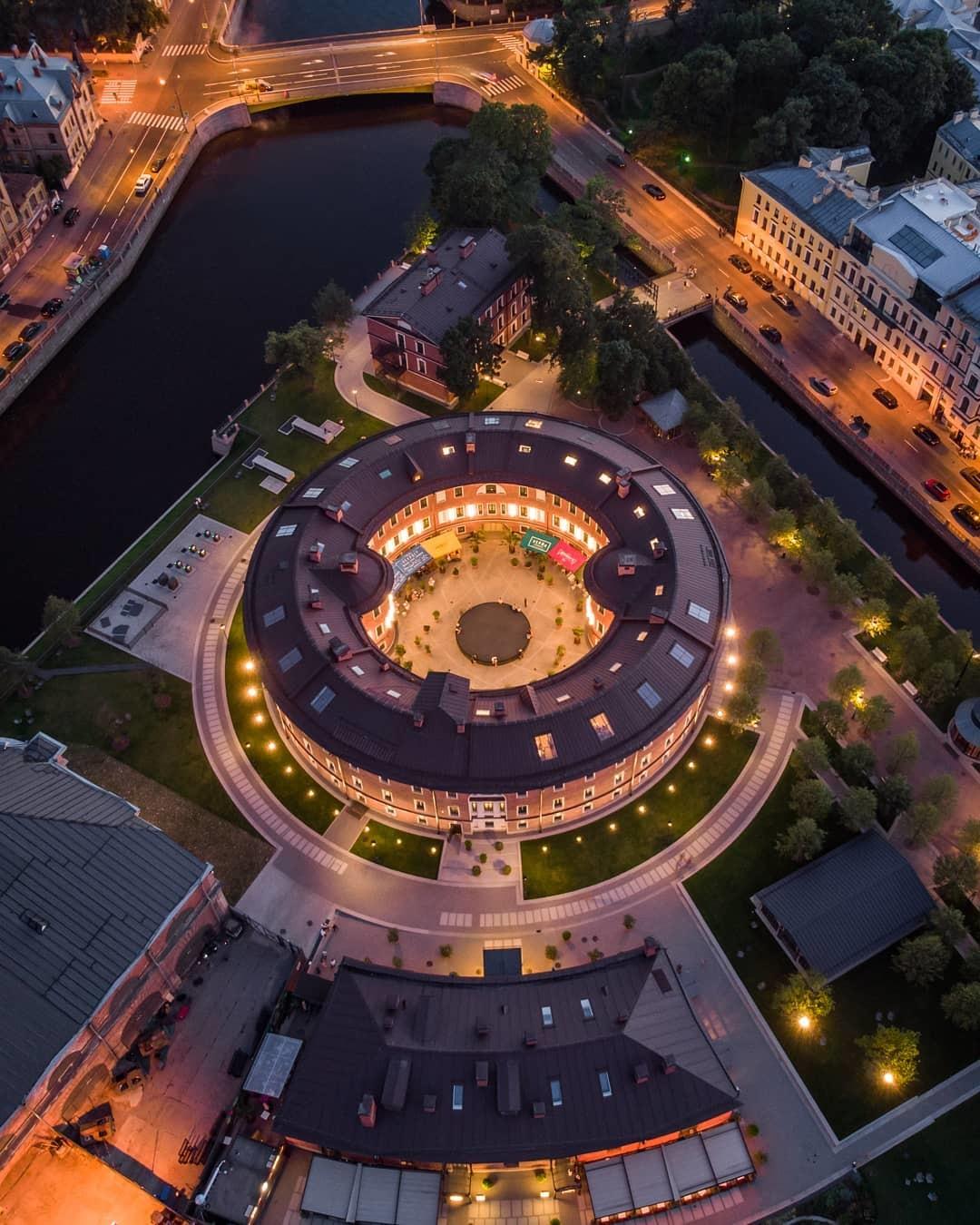
The history of New Holland is rich and varied. The inception of the triangular structure as it stands today began back in the 1730s under the auspices of Peter the Great. Seeking to build St. Petersburg up from the swampland, Peter the Great invited Dutch shipbuilders to work in the shipyards on the left hand bank of the River Neva. The area was colloquially nicknamed ‘New Holland’ and there are various theories behind the name. Some say it was named as such after the many Dutch shipbuilders who worked there but another theory suggests that it was named after the distinctly Dutch design of the barracks. New Holland underwent numerous stages of construction as well as renovation, beginning in 1732 under the control of the navy. One of the reasons the complex took so long to build, is that it so frequently changed architectural hands. Tracing the many names who are associated with New Holland’s designs is comparable to following a Game of Thrones style battle for control of the final project. One architect, Johann Gerard even ‘accidentally lost’ blueprints of which he didn’t approve! Structures of New Holland include the naval prison built in the early 1800s in response to the Decembrist uprising. The prison is a rounded form, which earnt it the nickname ‘The Bottle’, which is where the Russian expression ‘stay out of the Bottle’ came from.
The history of the complex took an interesting turn in 1890 when one of the buildings was converted from a one-storey meat locker into a Navy laboratory. Not only that, but the first water tank of Russia was built there to test out ships, the 6th of its kind in the world.
The water tank is the site where practically every model of ship or submarine was tested between 1910 and 1914, as well as seaplanes, which were invented in Russia. When in 1915, a radio station was installed on the island of New Holland, no one could have known that just two years later it would be the site of one of the most pivotal moments in Russia’s history. It was there on 9th November 1917, that Vladimir Lenin aired his earth-shattering broadcast which announced the start of the revolution.
During World War Two, New Holland was unsurprisingly significantly damaged by artillery fire, hit by more than seventy rounds of shelling and by more than ten bombings. Following the collapse of the Soviet Union, New Holland became a huge undertaking which was passed from one company to the next. However, each time, the future of the island fell victim to the events of the 20th century and for a long time the vision of its restoration was not realised.
Finally, in 2006, a competition was held to find the renovators of New Holland. The winners were Shalva Chigirinsky and Igor Kesaev, of CT Company, whose creative vision imagined a multi-faceted complex which was home to theatres, conference halls, galleries, hotels and restaurants. Plagued with bad luck, this plan for New Holland was never realised. The story however did not end there, and in 2010 a competition was held to find an investor in New Holland’s continued reconstruction. Millhouse won the bid and committed themselves to the ongoing renovation and restoration of the fascinating complex. Following that, the Iris Foundation organised a competition for architectural bids, and the American firm WORKac was appointed as consultants for the continued project. The fruits of that appointment are now visible as New Holland reopened in August 2016.
Summer Place
Since 2010, plans have been underway for a total renovation of the New Holland complex, to install museums and exhibition halls and educational facilities. Some of these projects are still a work in progress, but in the meantime, the island has plenty to offer.
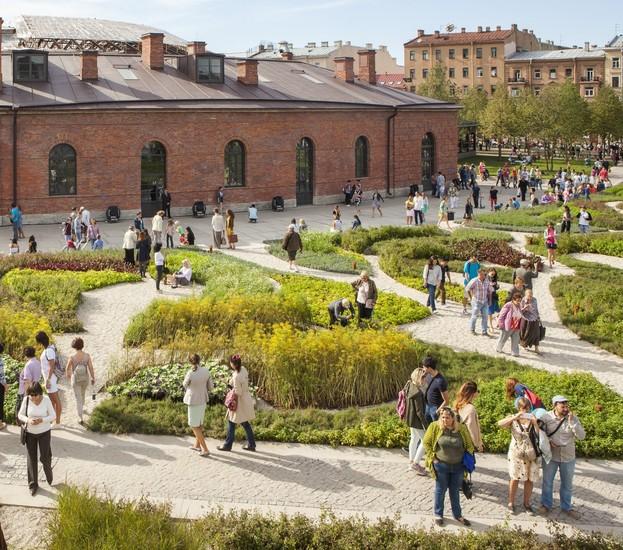
In summer visitors are able to enjoy public art displays, cafes, athletics fields, exhibitions, lectures, open-air markets, children’s parties and a whole host of other celebrations. New Holland has been rapidly transformed from a navy-owned structure with an embattled history, to a beautiful open space that can be enjoyed by all. The Iris Foundation who are cultivating this contemporary hub are truly taking advantage of the space offered on the island; in the parks there are cultural programmes on offer as well as sporting events, educational hubs and food stalls.
Summer at New Holland is always busy. The structure of New Holland may not seem entirely clear, but to give you a taster, think yoga on the grass, street food in the sun, table tennis, pop up art and sunbathing in one of the most historical sites of St. Petersburg. In the words of Dariya Zhukova herself, ‘Today we have an outdoor space, which dictates its own content: there is a park, where you can lie on the grass, a market with street food and vintage clothes, a shop with organic produce, a community garden and a site for rock-concerts and plays.’