
Portugal's southernmost region is not a city with a list of sights to tick off. It is 200 kilometres of coastline – cliffs, beaches, lagoons, hilltop castles, market towns, a nature reserve the size of a small country – that rewards having a car, a loose plan and a reasonable tolerance for driving on roads that occasionally seem to have been designed to make navigation difficult. The Algarve sold itself to mass tourism in the 1960s, and the central stretch between Lagos and Albufeira bears the consequences of that decision. But the region is large enough to absorb the crowds, and the further east or west you go, the better it gets.
The entries below cover ground from the far western tip of the continent to the quiet eastern lagoons on the Spanish border. Not all of them are within easy reach of each other, and that is as it should be. The prices below were correct when we wrote this – check the official websites before you visit, since these things shift.
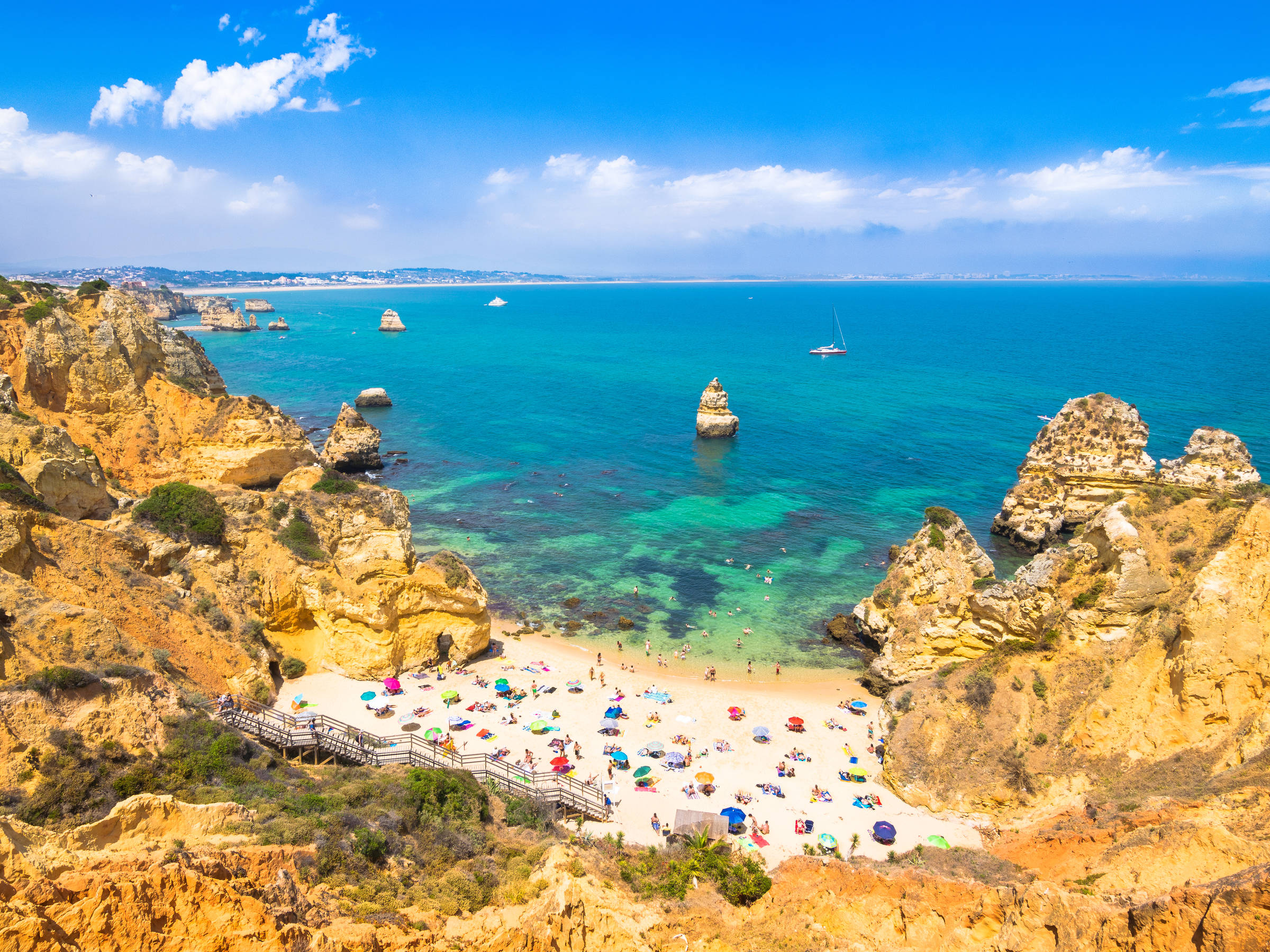
From the clifftop boardwalk, the scale of the rock formations is impressive but incomplete. The view that earns Ponta da Piedade its reputation is from the sea, which means either a small boat tour from Lagos Marina (around 75 minutes, departing through the day) or a kayak, which gets you through arches and into grottoes that the larger boats cannot enter. The staircase – 182 wooden steps carved into the cliff – descends to a small landing stage at the base where the boat tours pick up passengers. On foot, the coastal path from Lagos via Praia do Camílo takes about 40 minutes and passes several beaches along the way; it is the better approach if time allows.
Access has been regulated since 2023, and the current rules – no swimming to the cave, no disembarking inside – mean that the beach inside is no longer accessible to most visitors. Boat tours still enter the cave and the interior is fully visible from the water; the experience remains worthwhile. Small rigid inflatable boats can enter the cave; larger catamarans cannot. Tours depart from Portimão, Carvoeiro, Albufeira and other points along the coast, typically taking in several other caves and sea arches along the way. The coastline between Benagil and Portimão is exceptional even without the cave itself, and the boat tour is the best way to see it. From the clifftop above Benagil Beach, you can look down into the skylight and see the cave from above, which gives a good sense of the structure if you are not taking a boat.
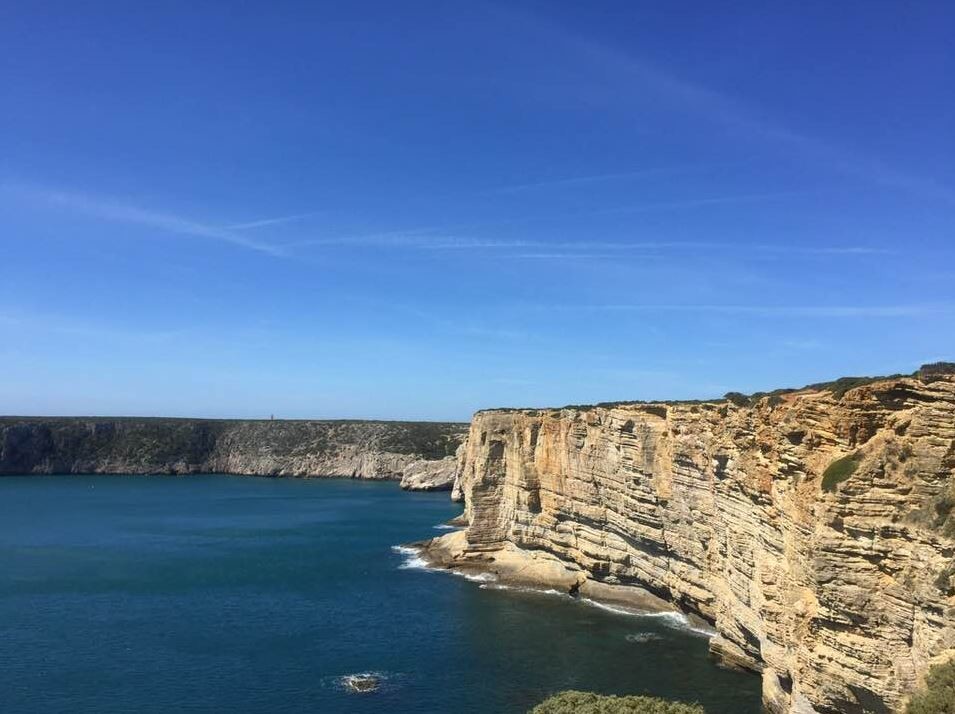
Seven kilometres to the east, the Fortaleza de Sagres occupies its own dramatic headland above the Bay of Sagres. The fortress was built in 1453 on the orders of Prince Henry the Navigator, who used this remote outpost as the base for organising Portugal’s age of exploration – the expeditions that would open West Africa, find the sea route to India and establish the first global maritime empire. The science of navigation, such as it existed in the 15th century, was developed here. Henry died at the fortress in 1460. Inside the walls is a large enigmatic wind compass rose carved into the ground, a small chapel dating from 1570, and the unmistakable sensation of being at the edge of the known world in an era when that phrase meant something.
The red sandstone castle that crowns the hilltop today is the largest and best-preserved Moorish fortification in the Algarve, built from blocks of local sandstone and taipa – a Moorish mixture of mud and sand that sets like stone – and equipped with eleven square towers. The ramparts are walkable and the views over the old town, the orange groves and the Arade River valley are considerable. Inside the walls, two ancient cisterns survive: one supplied water to the town until the 1990s, and a legend holds that on St. John’s night a Moorish princess can be heard lamenting her drowned lover at its edge. The Gothic cathedral below the castle, built on the ruins of the main mosque after the Christian reconquest, is worth visiting too. Silves itself – quiet, slightly time-worn, entirely lacking in the resort infrastructure of the coast – is one of the most agreeable towns in the Algarve for exactly that reason.
The lagoon is a major stopover on the Europe–Africa bird migration route, with over 300 species recorded. Greater flamingos are present year-round, with numbers peaking in autumn and winter; spoonbills, white storks, avocets and purple swamphens are among the other regulars. The Mediterranean chameleon has its main Portuguese population in the scrubland here. Boat tours through the inner lagoon channels depart from Faro and Olhão throughout the year, ranging from one-hour scenic cruises to half-day excursions with stops on the barrier islands. The Ludo Trail from Faro – a short walk along the lagoon edge – is the most accessible introduction to the park’s birdlife and requires nothing more than comfortable shoes.
The main draw is the Igreja do Carmo, a twin-towered baroque church completed in 1719 with the financial assistance of Brazilian gold, and the Capela dos Ossos attached to it. Built in the 19th century using the bones and skulls of 1,245 Carmelite monks exhumed from the cemetery, the Chapel of Bones follows a Portuguese tradition of monastic ossuary construction – Alcobaça and Évora have similar ones – but delivers the experience in a particularly compact and effective package. The bones line the walls from floor to ceiling. There are two mummified bodies, one of them a child. Above the entrance, a painted inscription reads: “We bones that are here, for yours we wait.” This is either profound or theatrical depending on your disposition, and possibly both.
By 1520 Tavira was the largest city in the Algarve. Then the tuna migration routes shifted, the river silted up, and the trade moved elsewhere. The buildings stayed. Today the town has 37 churches – more per capita than anywhere else in Portugal – baroque mansions with ornate doorways, orange-tree-shaded squares and a castle with Moorish walls offering views over the whole. The beach is on a barrier island, reached by a short ferry crossing, and the Ria Formosa lagoon starts at the edge of town. Tavira functions as an excellent base for exploring the eastern Algarve without surrendering to resort infrastructure.
Access is down a staircase from the clifftop car park, and the beach is not large, which means it fills quickly in high season. The clifftop walk in both directions from Marinha is part of the Seven Hanging Valleys Trail (Sete Vales Suspensos), a 6km route along the coast between Marinha and Praia de Benagil that passes a succession of viewpoints over beaches, caves and rock arches. It is among the finest coastal walks in Portugal and requires only moderate fitness. The trail can be done in either direction; starting from Marinha and walking east toward Benagil is marginally the better direction for the views.
The town of Monchique itself is a pleasant, slightly shabby market town with good restaurants and a weekly market. The drive to the summit of Foia, 8km above the town, passes through increasingly dramatic scenery and arrives at a viewpoint from which, on a clear day, you can see across the Alentejo plains to the north, the Atlantic coast to the south and, on exceptional days, the mountains of Morocco across the Strait of Gibraltar. It is 45 kilometres from Faro to Morocco. The Serra provides a useful and underused counterpoint to the coast – genuinely different in character, genuinely refreshing, and largely empty of tourists even in August.
The old town behind the market is worth an hour of exploration. The 13th-century castle, built by the Moors on the highest point and captured by the Order of Santiago in 1249, is partially restored and open to visitors; the views from the walls take in the rolling hills of the Barrocal limestone plain and, on a clear day, the distant coast. Loulé also has a well-regarded municipal museum, a covered market of azulejo-decorated stalls that operates daily, and a reputation for the Algarve’s most raucous Carnaval celebrations in February. It rewards being treated as a destination rather than a detour.
The Algarve’s food is dominated by seafood, and rightly so. Cataplana – a clam and pork stew cooked in a hinged copper vessel of the same name, of Moorish origin – is the regional dish and best eaten at a restaurant with a view of the water that produced the clams. The region’s white wines, particularly from the hills around Silves and Loulé, have improved dramatically over the past two decades and are worth investigating alongside the obligatory medronho. Almond and carob feature heavily in the pastry tradition, and the Dom Rodrigo – a sweet made from egg yolks and almonds, wrapped in silver foil – is the Algarve’s most distinctive confection, originally from Faro.
Day trips from the Algarve go in all directions. Évora, the walled Roman city in the Alentejo with its own Chapel of Bones, its Roman temple and its medieval streets, is around two hours by car from Faro and makes for a rewarding contrast with the coast. Sevilla is three hours by road from the eastern Algarve – an entirely feasible excursion for anyone with a car and an interest in Andalusia. The western surf beaches around Aljezur and Sagres, on the Costa Vicentina, offer a different and deliberately low-key Algarve that the main resort strip has not yet managed to absorb.
The entries below cover ground from the far western tip of the continent to the quiet eastern lagoons on the Spanish border. Not all of them are within easy reach of each other, and that is as it should be. The prices below were correct when we wrote this – check the official websites before you visit, since these things shift.
1. Ponta da Piedade, Lagos
The Ponta da Piedade headland, two and a half kilometres south of Lagos, is the geological showpiece of the western Algarve: a labyrinth of golden limestone pillars, arches, grottoes and sea caves carved by the Atlantic over roughly 20 million years. The cliffs rise up to 20 metres from the water, stratified in ochre, cream and burnt sienna, and the sea between them runs a shade of turquoise that photographs cannot adequately reproduce. Its name – Point of Mercy – came from the fishing families who would gather here during storms to pray for their men at sea. The lighthouse at the tip of the headland, built in 1913 and still operational, can be seen from the top of the cliffs once stood a 16th-century hermitage.From the clifftop boardwalk, the scale of the rock formations is impressive but incomplete. The view that earns Ponta da Piedade its reputation is from the sea, which means either a small boat tour from Lagos Marina (around 75 minutes, departing through the day) or a kayak, which gets you through arches and into grottoes that the larger boats cannot enter. The staircase – 182 wooden steps carved into the cliff – descends to a small landing stage at the base where the boat tours pick up passengers. On foot, the coastal path from Lagos via Praia do Camílo takes about 40 minutes and passes several beaches along the way; it is the better approach if time allows.
- Location: 2.5km south of Lagos town centre. Drive, taxi, or walk the coastal path. No public transport outside summer, when a tourist train runs from Lagos.
- Best time to visit: Early morning in summer before the boat tours build up; spring and autumn for the full clifftop walk without the crowds. Avoid visiting in strong westerly winds, when the sea at the base becomes dangerous.
- Ticket prices: The headland is free to visit. Boat tours from Lagos Marina cost around €20–€25 per person. Kayak tours are similarly priced.
- Good to know: The fishermen who run the boats from the staircase landing stage have been naming the rock formations for generations. The cathedral, the camel, the submarine and the grotto of love are among the more evocative. They are doing their best.
2. Benagil Cave
The Algar de Benagil is a sea cave on the coast between Carvoeiro and Lagoa, and it has become one of the most photographed places in Portugal. The cave has two sea-level entrances and a large circular hole in its ceiling – the “eye” – through which sunlight pours onto a small beach inside, turning the water the kind of blue that makes people suspect digital enhancement. It does not look real, and it is real, which is part of the problem: everyone wants to see it.Access has been regulated since 2023, and the current rules – no swimming to the cave, no disembarking inside – mean that the beach inside is no longer accessible to most visitors. Boat tours still enter the cave and the interior is fully visible from the water; the experience remains worthwhile. Small rigid inflatable boats can enter the cave; larger catamarans cannot. Tours depart from Portimão, Carvoeiro, Albufeira and other points along the coast, typically taking in several other caves and sea arches along the way. The coastline between Benagil and Portimão is exceptional even without the cave itself, and the boat tour is the best way to see it. From the clifftop above Benagil Beach, you can look down into the skylight and see the cave from above, which gives a good sense of the structure if you are not taking a boat.
- Location: Near the village of Benagil, between Carvoeiro and Armação de Pêra. The nearest town with easy access is Carvoeiro or Portimão.
- Best time to visit: Early morning for calmer seas and softer light inside the cave. Spring and autumn for smaller groups on the boats.
- Ticket prices: Boat tours cost around €20–€35 per person depending on departure point and tour length. Kayak tours with a guide are similarly priced and offer access to smaller caves.
- Good to know: Rules around access have changed more than once and may change again. Check current regulations before booking, and confirm with your tour operator that their boat is small enough to enter the cave.
3. Cape St. Vincent and Sagres Fortress
The Cabo de São Vicente is the southwesternmost point of continental Europe, and it feels like it. The cliffs drop 75 metres into the Atlantic on three sides, the wind comes straight off the ocean with nothing to interrupt it since North America, and the lighthouse – the most powerful in Europe – sits at the very edge. The Romans called this headland Promontorium Sacrum (the Sacred Promontory) and believed the gods gathered here at sunset. It is not difficult to see why they reached that conclusion.Seven kilometres to the east, the Fortaleza de Sagres occupies its own dramatic headland above the Bay of Sagres. The fortress was built in 1453 on the orders of Prince Henry the Navigator, who used this remote outpost as the base for organising Portugal’s age of exploration – the expeditions that would open West Africa, find the sea route to India and establish the first global maritime empire. The science of navigation, such as it existed in the 15th century, was developed here. Henry died at the fortress in 1460. Inside the walls is a large enigmatic wind compass rose carved into the ground, a small chapel dating from 1570, and the unmistakable sensation of being at the edge of the known world in an era when that phrase meant something.
- Location: Cape St. Vincent is 6km west of Sagres town. The fortress is 1km southwest of Sagres. Both are around 30km from Lagos by car.
- Best time to visit: Sunset at Cape St. Vincent is one of the great Algarve experiences, though the car park fills early in summer. The fortress is best visited on a weekday morning before tour groups arrive.
- Ticket prices: Sagres Fortress: €3 adults. Cape St. Vincent is free to visit; there is a lighthouse museum with a small entrance fee.
- Good to know: Francis Drake raided and burned the fortress in 1587 – somewhat ungrateful given that the Portuguese had spent the previous century opening up the world. The 1755 earthquake damaged it further. What stands today is substantially restored.
4. Silves Castle
Before Faro, before Lagos, the capital of the Algarve was Silves – or Xelb, as the Moors called it, who built its castle in the 8th or 9th century on the site of earlier Roman fortifications and made it one of the most prosperous cities in Iberia. At its peak the city had palaces, mosques, schools and a population that contemporary sources suggest rivalled Lisbon. In 1189, King Sancho I besieged it with the help of English, German and Flemish crusaders passing through on their way to the Holy Land. The Moors surrendered after six weeks. Two years later, they took it back. It was not definitively captured for Portugal until 1242.The red sandstone castle that crowns the hilltop today is the largest and best-preserved Moorish fortification in the Algarve, built from blocks of local sandstone and taipa – a Moorish mixture of mud and sand that sets like stone – and equipped with eleven square towers. The ramparts are walkable and the views over the old town, the orange groves and the Arade River valley are considerable. Inside the walls, two ancient cisterns survive: one supplied water to the town until the 1990s, and a legend holds that on St. John’s night a Moorish princess can be heard lamenting her drowned lover at its edge. The Gothic cathedral below the castle, built on the ruins of the main mosque after the Christian reconquest, is worth visiting too. Silves itself – quiet, slightly time-worn, entirely lacking in the resort infrastructure of the coast – is one of the most agreeable towns in the Algarve for exactly that reason.
- Location: Silves town, around 15km northeast of Portimão and 25km from Albufeira. Reachable by train (station is 2km from town) or car.
- Best time to visit: Spring and autumn, when the orange groves are fragrant and the summer crowds absent. August brings a Medieval Fair around the castle that recreates life in the 11th to 13th centuries, with its own currency.
- Ticket prices: €2.80 for adults; combined ticket with the Archaeological Museum is €3.90. Remarkably good value.
- Good to know: The archaeological museum next to the old city wall is built around a 12th-century Moorish cistern discovered during excavations in the 1980s. Easily combined with the castle in the same visit.
5. Ria Formosa Natural Park
The Ria Formosa stretches for 60 kilometres along the eastern Algarve coastline from Faro to Tavira: a system of lagoons, salt marshes, tidal mudflats and barrier islands that functions as one of Europe’s most important coastal wetlands. It was designated a Natural Park in 1987, voted one of Portugal’s seven natural wonders in 2010, and covers around 18,400 hectares of coastline that looks and feels entirely unlike the cliff-backed beaches of the western Algarve. The islands – Barreta, Culatra, Armona, Tavira, Cabanas – are accessible by ferry from Faro, Olhão and Tavira, and the beaches on their seaward side are among the finest and least crowded in Portugal.The lagoon is a major stopover on the Europe–Africa bird migration route, with over 300 species recorded. Greater flamingos are present year-round, with numbers peaking in autumn and winter; spoonbills, white storks, avocets and purple swamphens are among the other regulars. The Mediterranean chameleon has its main Portuguese population in the scrubland here. Boat tours through the inner lagoon channels depart from Faro and Olhão throughout the year, ranging from one-hour scenic cruises to half-day excursions with stops on the barrier islands. The Ludo Trail from Faro – a short walk along the lagoon edge – is the most accessible introduction to the park’s birdlife and requires nothing more than comfortable shoes.
- Location: Stretching along the eastern Algarve from Faro to Cacela Velha. Main access points are Faro, Olhão, Fuseta and Tavira.
- Best time to visit: Spring (April–May) for migrating birds and wildflowers; autumn (September–October) for flamingo numbers and warm water; winter for solitude and resident birdwatching.
- Ticket prices: The park itself is free. Ferry crossings to the barrier islands cost around €2–€4 return. Guided boat tours typically cost €20–€40 per person.
- Good to know: The island beaches are car-free. This is the point.
6. Faro Old Town and the Chapel of Bones
Faro is the regional capital, the transport hub and the place most Algarve visitors pass through without stopping. This is a mistake. The Cidade Velha – the old walled town – sits behind Roman walls that were rebuilt by the Moors and updated by the Portuguese, and contains a cathedral, several fine baroque churches, elegant squares and the kind of worn, unhurried atmosphere that distinguishes a working city from a resort. It was substantially destroyed by the 1755 earthquake and by subsequent Anglo-Dutch bombardment during the War of the Spanish Succession, but enough survived or was rebuilt in the 18th century to make it worth several hours of serious attention.The main draw is the Igreja do Carmo, a twin-towered baroque church completed in 1719 with the financial assistance of Brazilian gold, and the Capela dos Ossos attached to it. Built in the 19th century using the bones and skulls of 1,245 Carmelite monks exhumed from the cemetery, the Chapel of Bones follows a Portuguese tradition of monastic ossuary construction – Alcobaça and Évora have similar ones – but delivers the experience in a particularly compact and effective package. The bones line the walls from floor to ceiling. There are two mummified bodies, one of them a child. Above the entrance, a painted inscription reads: “We bones that are here, for yours we wait.” This is either profound or theatrical depending on your disposition, and possibly both.
- Location: Faro city centre. The old town and the Igreja do Carmo are both within walking distance of the bus and train stations.
- Best time to visit: Faro is far less crowded than the resort towns and can be visited comfortably any time of year. The old town is best in the morning.
- Ticket prices: The Igreja do Carmo and Chapel of Bones charge a combined entry of around €4 for adults. The old town is free to wander.
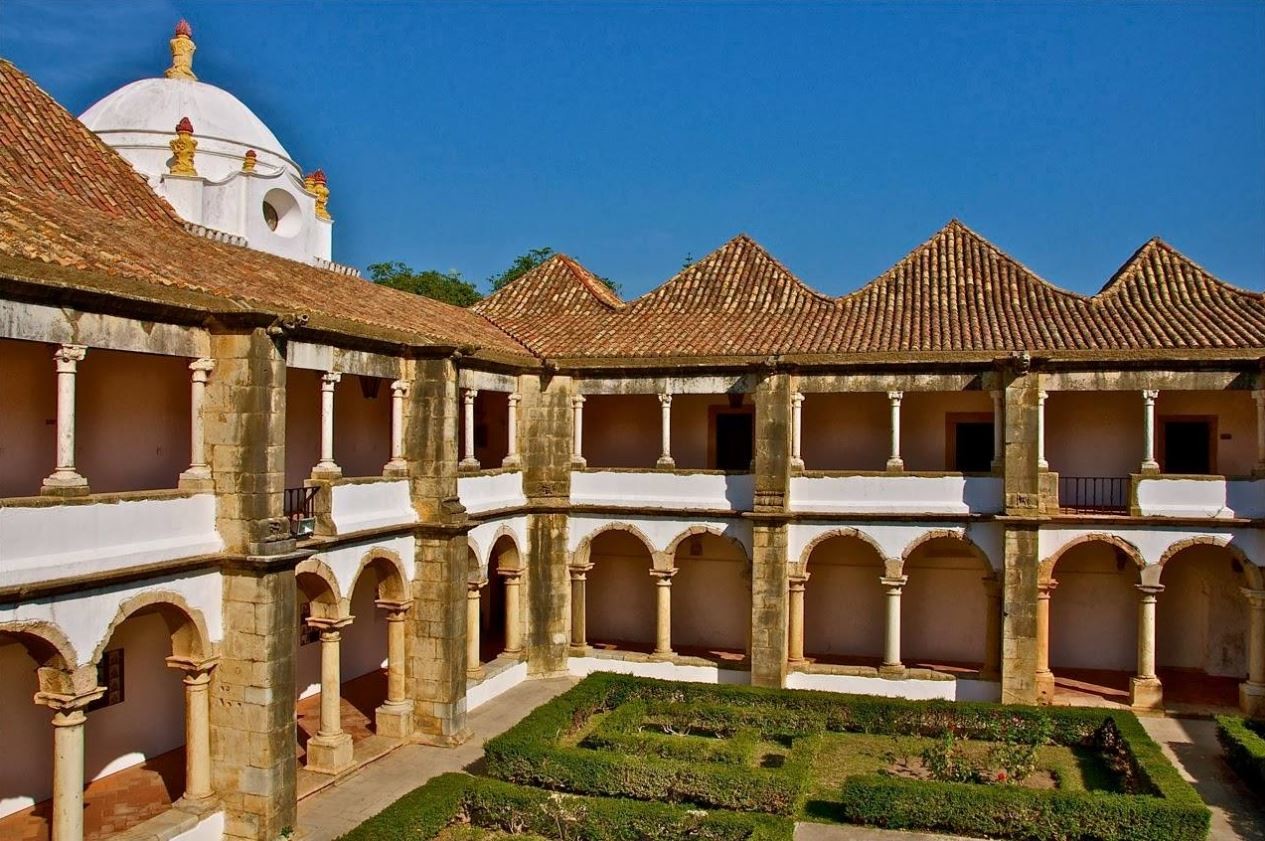
- Good to know: Faro also has a genuinely good municipal museum in the old convent of Nossa Senhora da Assunção, with Roman mosaics and a substantial collection of Algarve archaeological finds. It is quietly excellent and almost always uncrowded.
7. Tavira
Tavira is the most elegant town in the Algarve, which it achieves partly through good bones and partly through the kind of benign neglect that preserved its 18th-century architecture simply because nobody could afford to pull it down. The town spreads across both banks of the River Gilão, connected by the seven-arched Ponte Romana – which is not, despite the name, Roman, but rather a 12th-century Moorish bridge rebuilt in 1667 after flood damage. The distinctive four-sided telhados de tesoura (scissor roofs) that define Tavira’s skyline are found almost nowhere else in Portugal; their origins are debated, with some historians pointing to East Asian influence brought back by the Portuguese traders who made this the busiest port in the Algarve in the 15th century.By 1520 Tavira was the largest city in the Algarve. Then the tuna migration routes shifted, the river silted up, and the trade moved elsewhere. The buildings stayed. Today the town has 37 churches – more per capita than anywhere else in Portugal – baroque mansions with ornate doorways, orange-tree-shaded squares and a castle with Moorish walls offering views over the whole. The beach is on a barrier island, reached by a short ferry crossing, and the Ria Formosa lagoon starts at the edge of town. Tavira functions as an excellent base for exploring the eastern Algarve without surrendering to resort infrastructure.
- Location: 30km east of Faro on the EN125, easily reached by train from Faro or Lagos.
- Best time to visit: Spring and early autumn. August is busy with Portuguese holidaymakers, which is a different and more authentic kind of busy than the resort towns further west.
- Ticket prices: The castle is free to enter. The ferry to Ilha de Tavira costs around €2 return. Most churches are free.
- Good to know: King João I landed at Tavira after the conquest of Ceuta in 1415 and knighted both Prince Henry the Navigator and his brother Dom Pedro here on the quayside. There is a plaque. There should be a bigger plaque.
8. Praia da Marinha
Praia da Marinha is consistently ranked among the most beautiful beaches in Europe, and for once this is not hollow marketing copy. Located near Carvoeiro in the central Algarve, the beach sits in a sheltered cove between towering limestone cliffs, with sea arches, rock pillars and a network of caves visible from the water’s edge. The cliff formations here are among the most complex on the coast, carved by the same geological processes as Ponta da Piedade and Benagil, and the beach itself – relatively small, backed by golden rock, with water that clears to extraordinary depths on calm days – is the best advertisement the Algarve has for the quality of its natural coastline.Access is down a staircase from the clifftop car park, and the beach is not large, which means it fills quickly in high season. The clifftop walk in both directions from Marinha is part of the Seven Hanging Valleys Trail (Sete Vales Suspensos), a 6km route along the coast between Marinha and Praia de Benagil that passes a succession of viewpoints over beaches, caves and rock arches. It is among the finest coastal walks in Portugal and requires only moderate fitness. The trail can be done in either direction; starting from Marinha and walking east toward Benagil is marginally the better direction for the views.
- Location: Near Carvoeiro, about 5km east of the village. Drive or taxi; no public transport direct to the beach.
- Best time to visit: Early morning in summer before the car park fills; spring and autumn for the clifftop walk without the heat.
- Ticket prices: The beach is free. Parking at the clifftop car park is charged in summer.
- Good to know: The cave network below the cliffs at the western end of the beach is accessible on foot at low tide. The quality of snorkelling here, when the sea is calm, is exceptional.
9. Serra de Monchique
The Serra de Monchique is the Algarve’s inland escape: a range of forested hills rising to 902 metres at Foia, the highest point in southern Portugal, sitting behind the coast like a geographical surprise for anyone who assumed the entire region was beaches and cliffs. The hills are covered in eucalyptus, cork oak, chestnut and strawberry trees – the strawberry tree produces a fruit from which medronho, the regional firewater, is distilled – and the climate is noticeably cooler and damper than the coast, which is why the Romans built thermal baths at Caldas de Monchique and subsequent generations kept using them.The town of Monchique itself is a pleasant, slightly shabby market town with good restaurants and a weekly market. The drive to the summit of Foia, 8km above the town, passes through increasingly dramatic scenery and arrives at a viewpoint from which, on a clear day, you can see across the Alentejo plains to the north, the Atlantic coast to the south and, on exceptional days, the mountains of Morocco across the Strait of Gibraltar. It is 45 kilometres from Faro to Morocco. The Serra provides a useful and underused counterpoint to the coast – genuinely different in character, genuinely refreshing, and largely empty of tourists even in August.
- Location: Monchique town is around 25km north of Portimão. Foia summit is 8km west of the town by a scenic mountain road. A car is essential.
- Best time to visit: Spring for wildflowers and clear views; autumn for the medronho harvest. Summer afternoons can have haze that reduces the summit views.
- Ticket prices: Free. The thermal baths at Caldas de Monchique charge for spa treatments.
- Good to know: Caldas de Monchique, 6km south of Monchique town, is a spa village with a spring that has been bottled commercially since 1774. It is also the starting point of some good walking trails through the valley.
10. Loulé Market and Old Town
Loulé is the Algarve’s largest inland municipality and home to the best market in the region, held every Saturday morning in a Moorish-style building of extravagant ambition on the edge of the old town. The market building – built in 1908 with neo-Moorish domes, arches and terracotta façades – is an architectural curiosity that looks like it arrived from a different continent, which is perhaps appropriate for a town with deep Moorish roots. Inside, vendors sell fresh fruit and vegetables, local cheeses, smoked sausages, almonds, dried figs, honey, carob and locally caught fish. It is a functioning food market with a tourist layer grafted over the top; the balance is better maintained than in many Algarve markets.The old town behind the market is worth an hour of exploration. The 13th-century castle, built by the Moors on the highest point and captured by the Order of Santiago in 1249, is partially restored and open to visitors; the views from the walls take in the rolling hills of the Barrocal limestone plain and, on a clear day, the distant coast. Loulé also has a well-regarded municipal museum, a covered market of azulejo-decorated stalls that operates daily, and a reputation for the Algarve’s most raucous Carnaval celebrations in February. It rewards being treated as a destination rather than a detour.
- Location: 15km north of Faro, easily reached by car or bus. The Saturday market runs from roughly 8am to 1pm.
- Best time to visit: Saturday morning for the market. The town is worth visiting any day, but the weekly market is the main event.
- Ticket prices: The market is free to enter. The castle charges a small admission; check the official website for current prices.
- Good to know: Loulé is also the administrative centre of the Algarve’s largest municipality, which encompasses some of the most unspoiled inland villages in the region. The villages of Querença, Salir and Alte – all within 20 minutes of Loulé – are worth seeking out for anyone who wants to see the Algarve before tourism found it.
What else can you see in the Algarve?
The ten entries above cover the region’s range reasonably well, but there are significant omissions. Lagos old town itself – the walled historic centre that was the Algarve’s capital from 1576 to 1756 – has genuine character, with the Slave Market Museum occupying a building believed to be the site of Europe’s first slave market, where enslaved people from West Africa were auctioned from 1444. It is a confronting and important exhibition. Albufeira has a legitimate claim on the list for its beaches and its Old Town, which survives beneath the resort superstructure, though anyone who has been to Ibiza in August will find the nightlife strip familiar. The town’s cliffs and beaches – particularly Praia de São Rafael and Praia da Falésia, a 5km stretch of striped ochre cliffs east of town – are genuinely exceptional. Olhão, the largest fishing town in the Algarve, has its own character entirely: flat-roofed white cube houses that earned it the nickname “the cubist city,” a pair of large covered markets on the waterfront, and ferry access to the Ria Formosa islands.The Algarve’s food is dominated by seafood, and rightly so. Cataplana – a clam and pork stew cooked in a hinged copper vessel of the same name, of Moorish origin – is the regional dish and best eaten at a restaurant with a view of the water that produced the clams. The region’s white wines, particularly from the hills around Silves and Loulé, have improved dramatically over the past two decades and are worth investigating alongside the obligatory medronho. Almond and carob feature heavily in the pastry tradition, and the Dom Rodrigo – a sweet made from egg yolks and almonds, wrapped in silver foil – is the Algarve’s most distinctive confection, originally from Faro.
Day trips from the Algarve go in all directions. Évora, the walled Roman city in the Alentejo with its own Chapel of Bones, its Roman temple and its medieval streets, is around two hours by car from Faro and makes for a rewarding contrast with the coast. Sevilla is three hours by road from the eastern Algarve – an entirely feasible excursion for anyone with a car and an interest in Andalusia. The western surf beaches around Aljezur and Sagres, on the Costa Vicentina, offer a different and deliberately low-key Algarve that the main resort strip has not yet managed to absorb.