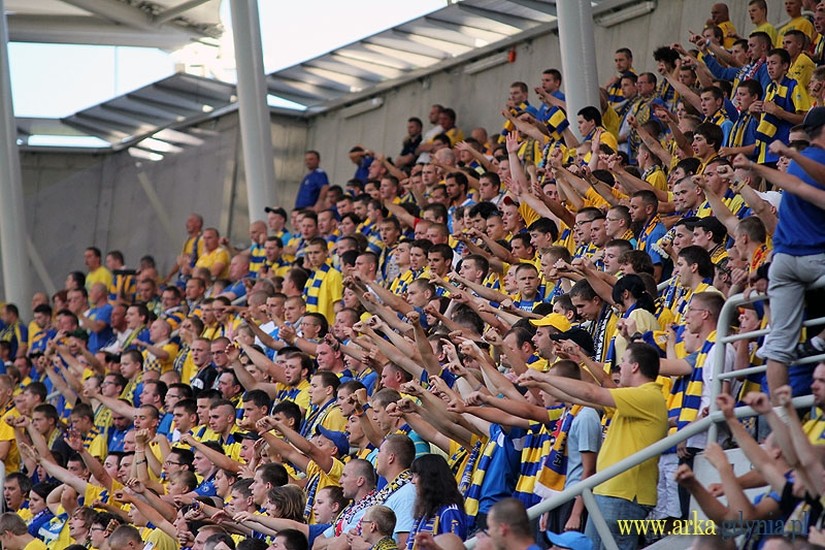
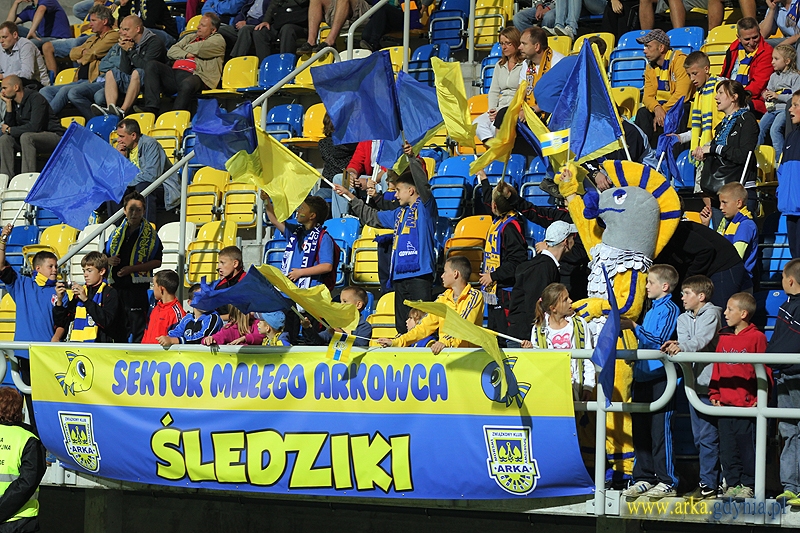
The Tri-city is home to two professional football clubs – Lechia Gdansk and Arka Gdynia. While neither have troubled the trophy engravers a great deal during their history (although that changed in 2017 when Arka surprisingly won the 2016/17 Polish Cup and the 2017/18 Polish Super Cup), both enjoy decent local support and each set of supporters see the other as their major rivals. With the two teams only occasionally being in the same division as each other at the same time, these rivalries are generally lived out through graffiti around the city. On those occasions when they do come up against each other though trouble has been known to flare between the more troublesome elements of each clubs’ supporters.
Both clubs now play in very good stadiums and attendances are on the rise. If you are in town and want to sample a bit of local sporting culture, either club is worth a visit, but don’t expect too much in the way of quality. Despite more money being invested in the sport and with Canal Plus giving the top division (the wonderfully named Ekstraklasa) lots of exposure, it is still a fact that the best Polish players ply their trades abroad. The absence of a Polish club in the group stage of the Champions league in the period from the 1996/97 to 2016/17 seasons should tell you all you need to know about the relative strength of Polish domestic football.
If you're interested to know more about what's going on in the top division in Poland take a look at our season preview and follow the links there to more knowledgeable Polish football watchers than us.
Lechia Gdansk
The roots of football in Gdańsk/Danzig can be traced back to 1903, and the creation of Fußballclub Danzig. A new stadium was built in 1927 on what is now ul. Traugutta and in 1935 a modernization program was undertaken to make the arena one of the most advanced in this part of the world.
At the same time that Fußballclub Danzig were kicking their first ball a club called Lechia Lwow (Lechia is the historical name of Poland) was founded by students in the city of Lwow. The club played in the Polish league in the inter-war years, claiming runners-up spot in 1935. However, once WWII kicked off Lwow found itself under Soviet occupation, and both club and players disappeared. After the war the city was ceded to Ukraine and renamed Lviv – which it remains today - while German Danzig became Polish Gdańsk. Waves of Poles migrated westwards to Gdańsk, and in 1945 former residents of Lwow reactivated Waves of Poles migrated westwards to Gdańsk, and in 1945 some, including former residents of Lwow, created Lechia Gdańsk on the ul. Traugutta ground that had been home to Fußballclub Danzig. While the senior side now play their games at the Energa Stadium, Traugutta is still used for training and the matches of junior Lechia sides. It is also where the German national side trained during the Euro2012 tournament. Those interested in the club’s history might like this Facebook page which publishes old photos of the club back to the days of Lechia Lwow.
It is probably fair to say that there is no team in the Polish Ekstraklasa which has experienced as many ups and downs as Lechia Gdańsk. The low-point of the club's history was probably relegation to the third division in 1982, although it would in effect serve as a catalyst for what remains the team's finest hour the following year. Thanks to the coaching duo of Jerzy Jastrzębowski and Józef Gładysz, Lechia were promoted back to the second division in 1983, and, despite being the underdogs, defeated Piast Gliwice in that year's Polish Cup final. This triumph brought European football and the most famous night in the club’s history (see Solidarity F.C.)
This proved to be the high-water mark in the club’s history and by the 1990s things were looking bleak. With the club back in the third division, little investment and limited prospects, someone came up with a plan - ‘why wait for promotion when you can launch yourselves instantly into the premiership’.
The plot reads like an Ealing comedy. In 1995 a merger was proposed with first division Olimpia Poznań, who, anxious to escape the shadow of Lech Poznań, fell for the idea. However away teams refused to travel to Lechia, and the unimpressed FA – who hadn’t sanctioned the merger – awarded away teams an automatic three points. This culminated in a relegation decider with GKS Katowice, who refused to turn up, with the result seeing Lechia being turfed out of the league. What followed was meltdown. Players deserted likes rats and Lechia/Olimpia fell to the third division before Olimpia dissolved the merger and tried to scuttle back to Poznań (Lechia kept the name). Having failed disastrously with the merger idea, Lechia decided to have another go in 1998 and merged with Polonia Gdansk who were also in the third tier. Another relegation followed and Polonia left.
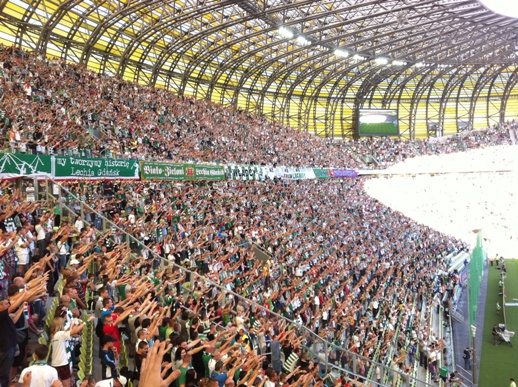
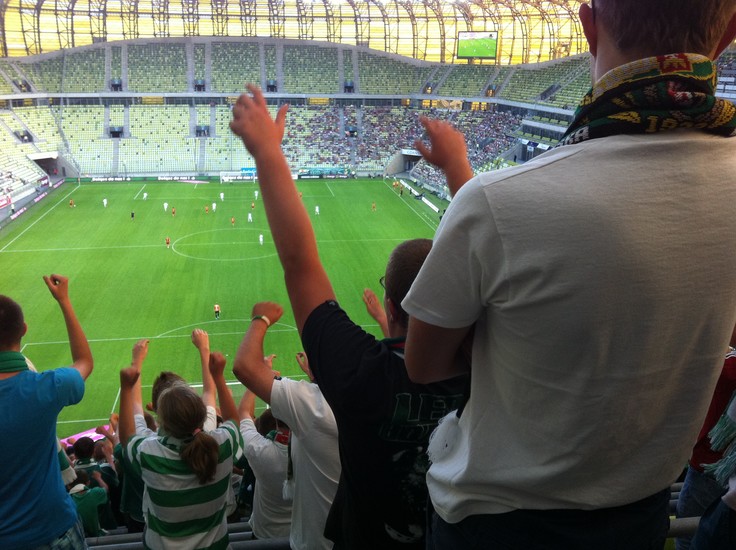
Disillusioned fans, who regularly organised collections to help pay the players’ wages decided enough was enough. Sensing the only way forward was to make a new start in what was effectively the sixth tier of Polish football, they re-booted the club as O.S.P. Lechia Gdansk in 2001 and this sense of a new-start and a new purpose had the desired effect. Lechia, supported by thousands of passionately loyal fans, quickly progressed through the lower leagues winning four successive promotions as champions and by 2008 they were back in the Ekstraklasa, the Polish top division. Though 2011/12 was a poor one on the pitch another milestone was achieved with the club moving from the familiar, but run-down Traugutta ground to the shining new PGE Arena. Built especially to host games in the EURO 2012 finals the stadium was officially opened with a 2-2 draw between the Polish national side and Germany. Lechia enjoyed a pre-Euro boost as well and the stadium saw the 40,000 seats nearly filled for its opening games (attendances have since dropped back into the teens), but the potential for the club, sitting as it does at the heart of a huge potential catchment area, remains huge. With Lech Walesa a proclaimed fan and both the President of the European Council - Donald Tusk - and the President of Gdansk - Pawel Adamowicz both die-hard Lechia supporters, the club has big hopes for the future.