Aruba sits 27 kilometres off the Venezuelan coast and makes no apologies for what it is. The island is small – 32 kilometres long, 10 wide – flat, dry, covered in cacti and almost constantly sunny, which makes it either paradise or a desert depending on how you feel about cacti. The trade winds blow in off the Atlantic with enough consistency to keep temperatures in the high twenties year-round and to ensure the western beaches are calm while the northeastern coast is a different proposition entirely: rough, windswept, and best admired from a distance. The island sits outside the hurricane belt, which means the question of when to visit is simpler than for most of the Caribbean. Any time is fine.
Tourism arrived in earnest in the 1970s and the hotel strip along Palm Beach has the look of a place that has been doing this for a while. But Aruba is considerably more than its resort corridor, and the entries below try to reflect that. Prices were correct when we wrote this; check before you go.
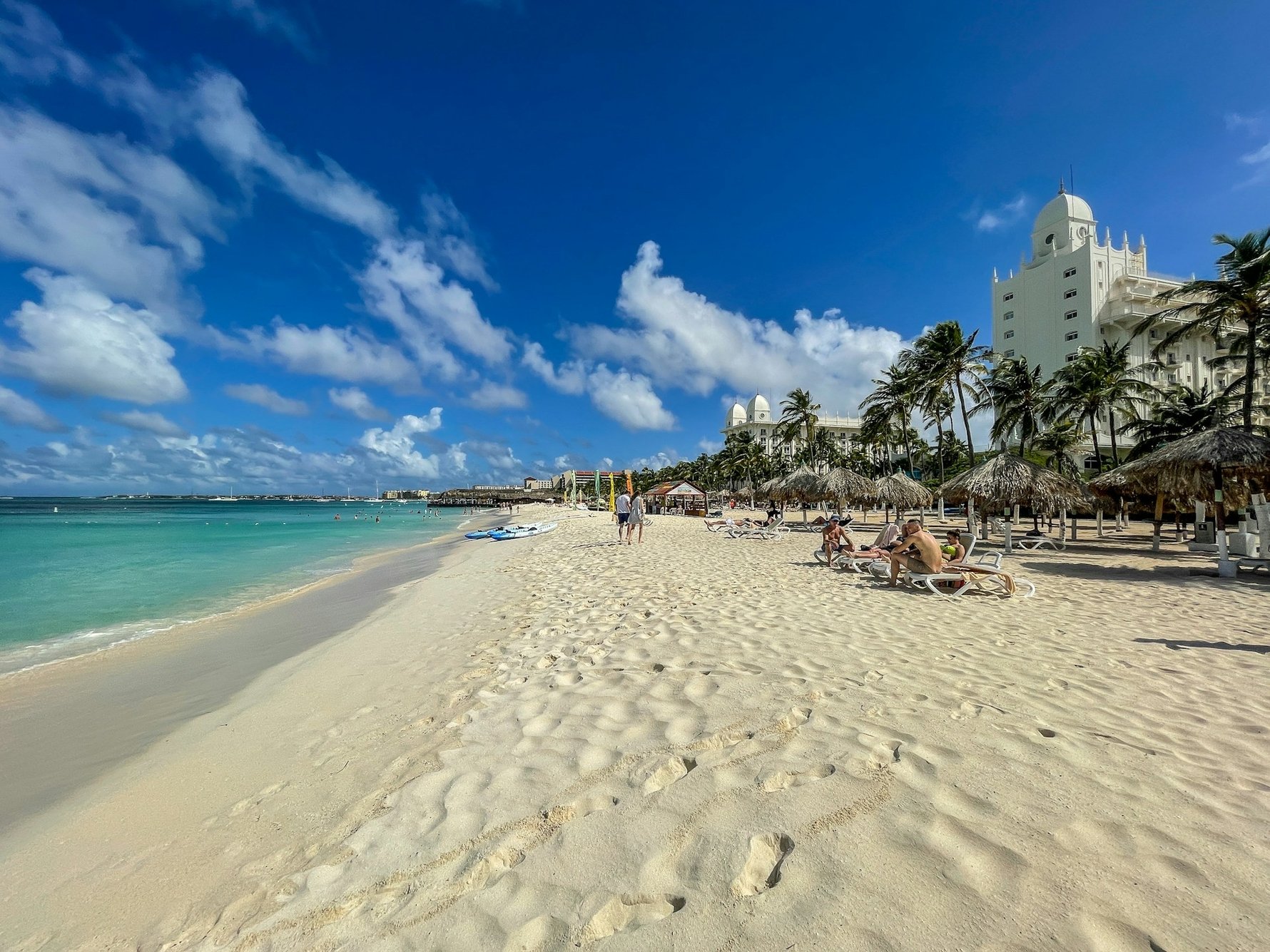
Consistently ranked among the finest beaches in the Caribbean, Eagle Beach earns the reputation without obviously trying. The sand is pale and fine, the water runs through shades of turquoise and aquamarine in the way that photographs but looks better in person, and the beach is wide enough that even in high season you can find space that doesn’t require negotiating with neighbouring sunbathers. This is not universally true of Caribbean beaches that carry the word “famous.”
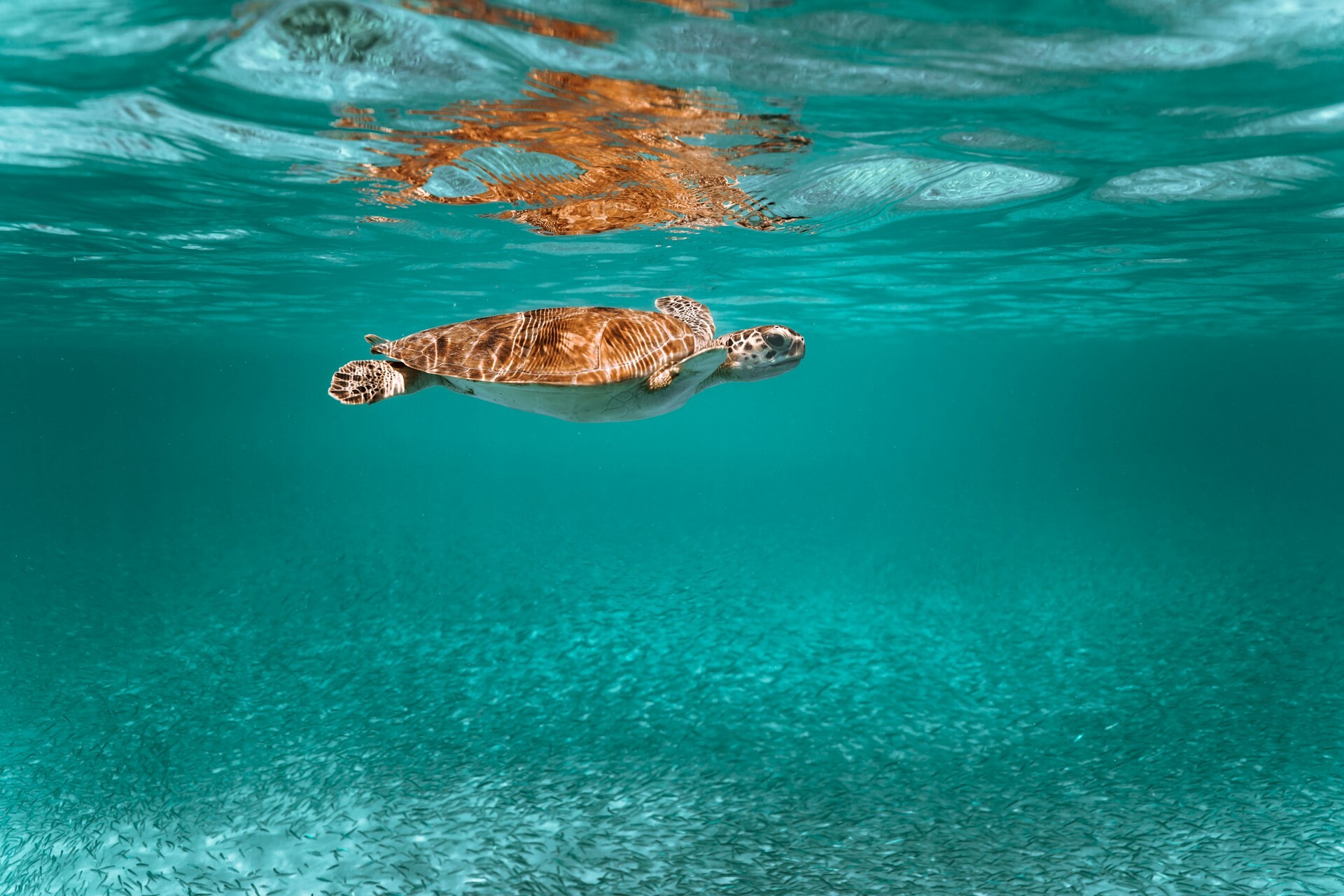
The beach is fronted by low-rise hotels rather than towers, which is part of why it feels less congested than the Palm Beach strip to the north. The fofoti trees – a mangrove species whose trunks twist and lean dramatically toward the sea under the influence of the perpetual trade winds – are the defining image of the beach and, by extension, of Aruba itself. They are protected by law, which is worth knowing before you hang anything on one. Between March and November, leatherback, hawksbill, green and loggerhead sea turtles nest on Eagle Beach, making it one of the most important turtle nesting sites in the southern Caribbean. If you are visiting in that window, the Turtugaruba Foundation runs a turtle watch programme through several of the beachfront resorts – witnessing a hatching is not something most people forget in a hurry.
Location: On the western coast, south of Palm Beach. Accessible by bus from Oranjestad (line 2 toward Eagle Beach) or by taxi; rental car makes it easier to arrive early and claim a spot.
Best time to visit: Early morning for the best light and the thinnest crowds; weekday mornings are considerably quieter than weekends. Turtle watch events happen at night and require registration through the resort programmes.
What to budget: The beach is free. Sunbed and umbrella rental from vendors on the beach costs around US$10–15 each. Free first-come palapas are available but go early.
Good to know: Eagle Beach is Blue Flag certified for water quality. The fofoti trees are not just photogenic but actively monitored – driving or parking on the sand or dunes is prohibited to protect nesting sites.
Arikok National Park
The side of Aruba that most visitors miss is the one that covers nearly a fifth of the island. Arikok National Park, established officially in 2000, protects 7,900 acres of the island’s northeastern interior and coastline: a landscape of volcanic rock, fossilised coral limestone, towering cacti, dry riverbeds and dramatic cliffs that drops into the Atlantic with no warning and no softening. This is the part of the island where the trade winds arrive having crossed the open ocean, and the terrain looks accordingly weatherbeaten. It is also where Aruba’s two highest points are located – the Jamanota hill at 188 metres and the Arikok hill at 176 metres, which qualifies as genuinely elevated on an island this flat.
The park’s highlights reward proper planning. Fontein Cave contains pre-Columbian pictographs painted in reddish-brown by the Arawak people roughly a thousand years ago – ochre figures on limestone that were once part of a sacred site and are now gated to prevent further deterioration. The crown jewel is Conchi, the Natural Pool: a saltwater pool enclosed by a ring of volcanic rock at the edge of the Atlantic, where the ocean crashes against the outer walls while the interior stays calm enough to swim in. Getting there requires either a 4WD vehicle, a 45-minute hike, or a guided ATV or horseback tour. The road is rough enough that a standard rental car is not going to make it. The wild donkeys, burrowing owls, Aruban whiptail lizards and the endemic Aruban rattlesnake – which is shy but present, and which argues for decent footwear on the trails – complete the picture of an ecosystem that operates on its own terms, regardless of what is happening on the resort strip 20 kilometres away.
Location: Northeastern Aruba; main entrance at San Fuego, around 30 minutes by car from Oranjestad or Palm Beach.
Best time to visit: Early morning, before the heat builds. The park is open year-round. Book guided tours to Conchi in advance in high season – the limited access road means tour capacity is restricted.
What to budget: Park entrance is around US$11, payable at the visitor centre. Guided ATV or 4WD tours to Conchi typically cost US$70–120 per person depending on duration and operator.
Good to know: Take far more water than you think you need. There is almost no shade on the trails and the sun is direct. The visitor centre at the entrance provides a free park map and wristband, and the staff can advise on current trail and road conditions.
The Antilla Shipwreck
On the morning of 10 May 1940, Germany invaded the Netherlands. Aruba, as Dutch territory, was immediately on the other side of the war. A German cargo freighter called the Antilla – 122 metres long, launched from Hamburg the previous year, then sitting at anchor off Aruba’s western coast – was boarded during the night by Dutch marines who demanded its surrender. The captain refused to lower the gangway. He was told to reconsider overnight. He used the time to order his crew to open the sea valves and set fire to the engine room and holds. By the following morning the ship was burning and sinking. The crew abandoned ship, were arrested as they hit the water, and spent the rest of the war in a prison camp in Bonaire. The Antilla burned for several days before finally settling on its port side on the sandy bottom, where it has remained ever since.
At 122 metres, the Antilla is the largest shipwreck in the Caribbean accessible to divers. It lies between 5 and 18 metres below the surface, which makes the upper sections reachable by confident snorkellers and the full wreck accessible to certified divers at all levels. Over eight decades on the bottom have transformed it into an artificial reef encrusted with corals, sea fans and sponges, and home to moray eels, barracuda, schools of tropical fish and the occasional sea turtle. It is broken into sections now – the surge and currents have been at work for decades – but the scale of the hull is still apparent underwater, and the history is difficult to forget when you are swimming through it. Arubans call it the Ghost Ship. Dive operators across the island run tours to the site; snorkelling tours also visit the shallower sections of the wreck.
Location: Off the northwestern coast near Malmok, accessible only by boat. Dive and snorkel tours depart from operators along Palm Beach and the marina in Oranjestad.
Best time to visit: Morning dives typically have the best visibility. Conditions can be choppy in the afternoon when the trade winds pick up.
What to budget: Snorkelling tours to the Antilla typically cost US$62–79 per person, including gear. Certified dive tours run around US$114–125. Book through established operators – most Palm Beach hotels can arrange this directly.
Good to know: The Antilla is not the only wreck in Aruban waters. The island has more than a dozen dive sites including a deliberately sunk aeroplane and a tugboat, making it one of the better wreck-diving destinations in the Dutch Caribbean.
Oranjestad
The capital of Aruba is small enough to walk across in twenty minutes and Dutch enough to feel, in places, like someone has transplanted a canal town to the tropics and painted it considerably brighter than the original. The architecture along the waterfront and the main streets is a mix of 19th-century Dutch colonial and more recent construction in the same style – mustard yellows, terracotta reds, faded blues – and the effect is more coherent than it sounds. The cruise ship terminal deposits a significant proportion of its passengers directly into the shopping district, which does not improve certain parts of the centre, but the streets away from the main strip are quieter and more rewarding.
The essential stop is Fort Zoutman, the oldest building on the island. Construction began in 1796 using materials provided by the indigenous population and labour from enslaved people brought from Curaçao; the fort was completed in 1798 and named after Dutch rear admiral Johan Arnold Zoutman, who never set foot on Aruba. The Willem III Tower was added in 1868 as a lighthouse and clock tower; it served variously as a courthouse, library, post office and police station before being converted into a museum in 1983 along with the fort. UNESCO has recognised the complex as a Place of Memory of the Slave Trade Route. On Tuesday evenings the courtyard hosts the Bon Bini Festival – “bon bini” meaning welcome in Papiamento, the island’s native creole language – with live music, dancing and local food. A short walk away, the National Archaeological Museum has an excellent collection covering Aruba’s pre-Columbian history, including the Caqutió people who inhabited the island for centuries before European contact.
Location: The capital, on the southwestern coast. Fort Zoutman is on Zoutmanstraat, a short walk from the waterfront. The National Archaeological Museum is nearby on Schelpstraat.
Best time to visit: Early morning before cruise ship passengers arrive; Tuesday evenings for the Bon Bini Festival. Avoid the centre entirely on days when multiple large ships are docked simultaneously – the port authority website publishes the schedule.
What to budget: Fort Zoutman museum entry is around US$5. The National Archaeological Museum charges a similar small fee. The Bon Bini Festival charges around US$15 for entry including the performance.
Good to know: Papiamento – the lingua franca of Aruba, Bonaire and Curaçao – is a creole language with roots in Portuguese, Spanish, Dutch, African languages and Arawak. It is the first language of most Arubans and is notably different from the Papiamentu spoken on Curaçao and Bonaire. The difference is enough to occasionally cause misunderstandings between islands.
California Lighthouse
The California Lighthouse stands at the northwestern tip of Aruba on a limestone plateau called Hudishibana, 30 metres tall, white and conspicuous against the surrounding rock and scrub. It was built between 1914 and 1916 – designed by French architect Léon Jean Marie Bourgeois, who drew on the design of France’s oldest lighthouse, the Cordouan – and named after a British steamship that sank off the same stretch of coast on the night of 23 September 1891 while sailing from Liverpool to the Americas. The ship’s cargo washed ashore; the locals collected it to sell at market; two police officers were dispatched from Curaçao to stop them; the area had no name yet, so it was given the name of the ship that had wrecked there. The lighthouse was built specifically to prevent a repetition of the accident. It has been operational, in one form or another, ever since.
The Hudishibana plateau is one of the most dramatic landscapes on Aruba – jagged rock, crashing surf on three sides, and the kind of view that makes it easy to understand why the lighthouse was needed. The northwestern tip of the island faces the open Caribbean with nothing between it and the horizon, and the light was visible for miles in both directions along the coast. Today the lighthouse is primarily a tourist attraction and viewpoint; the surrounding area has a restaurant (built into the former lighthouse keeper’s house) and the nearby Arashi Beach, which is worth combining with a lighthouse visit. Local guides will sometimes tell visitors that the S.S. California was the ship that failed to respond to the Titanic’s distress calls. It was not. That was a different ship, the S.S. Californian. The guides know this, and the visitors generally don’t, and the story is good, so it persists.
Location: Northwestern tip of the island, near Arashi Beach. Around 15 minutes by car from the Palm Beach hotel strip.
Best time to visit: Late afternoon for the sunset views, which are spectacular. Early morning for the clearest light and fewest visitors.
What to budget: Around US$5 to climb the lighthouse. Guided tours of the island typically include a lighthouse stop.
Good to know: The terrain around the lighthouse is rough limestone and requires sturdy footwear. Sandals will make you regret them. The adjacent restaurant, La Trattoria el Faro Blanco, is a reliable option for lunch or dinner with views of the coast.
Baby Beach
At the southeastern tip of Aruba, a 35-minute drive from Oranjestad, Baby Beach – officially Klein Lagoen, though nobody calls it that – sits quietly outside the main resort circuit and is considerably better for it. The beach is a crescent-shaped, man-altered lagoon protected from the open sea by a rock barrier, with water that rarely exceeds waist depth, stays warm and calm in almost any weather, and is clear enough to see the sandy bottom from the shore. The calm came first; the name followed, because the water was safe enough for very small children. The Aruba Esso Club was built here in the 1950s as a recreation facility for the American workers at the nearby Lago Oil Refinery – one of the largest refineries in the world at the time – and the old structure is still visible at the western edge of the lagoon. The refinery itself is visible on the horizon, which bothers some visitors and is simply part of the landscape for everyone else.
The snorkelling, particularly around the seagrass beds on the left side of the lagoon and the deeper channel near the rock wall, is among the best accessible snorkelling on the island – parrotfish, barracuda, angelfish, squid, eels, and regular sea turtle sightings in the seagrass. The water is calm enough for complete beginners and children. A dive centre near the beach rents equipment. The beach is popular with local families on weekends; weekday mornings offer the experience in a considerably more peaceful register.
Location: Near Seroe Colorado, southeastern tip of Aruba. About 35 minutes by car from Oranjestad. A public bus serves the route, though infrequently – check the Arubus schedule.
Best time to visit: Weekday mornings for the quietest experience. Weekend afternoons bring large numbers of local families, which has its own appeal but also its own noise levels.
What to budget: Free to enter. Palapas are first-come, first-served at no charge. Snorkel gear rental from JADS Dive Center beside the beach is around US$10–15. Food vendors and a small bar operate on the beach.
Good to know: Do not swim through the opening in the rock barrier into the open sea. The currents on the other side are strong and the channel has claimed swimmers who underestimated them. The warning signs are there for good reason.
San Nicolas
Thirty kilometres southeast of Oranjestad, far from the hotel strip and easy to miss if nobody tells you it’s there, San Nicolas is the most interesting town on the island and the one most tourists never see. Locals call it Sunrise City, because it faces east. For most of the 20th century it was the island’s economic engine: the Lago Oil & Transport Company refinery, opened in 1924 to process crude oil shipped from Lake Maracaibo in Venezuela, employed over 10,000 people at its peak and made San Nicolas a busy, cosmopolitan industrial town. When Exxon closed the refinery in 1985, the town entered a long, quiet decline. It stayed quiet for thirty years.
Then in 2016, a local entrepreneur named Tito Bolívar, inspired by the street art scene he had seen in Bogotá, organised the first Aruba Art Fair and invited artists from across the world to paint the town’s blank walls. They did. The results – large-scale, technically accomplished murals covering the façades of former storefronts, warehouses and the side walls of old refinery-era buildings – have transformed San Nicolas into what Forbes has called the street art capital of the Caribbean. New works are added each year. The Museum of Industry, housed in the town’s old water tower, tells the story of the refinery years and the successive economic lives of the island through gold mining, aloe cultivation and oil. Charlie’s Bar, which has been open on Wilhelminastraat since 1941, is the oldest bar on the island and has the kind of interior – memorabilia from eight decades of sailors, workers and visitors covering every available surface – that money cannot manufacture. A morning in San Nicolas, combined with an afternoon at nearby Baby Beach, makes for the most honest and least resort-filtered day on the island.
Location: Southeastern Aruba, around 30 minutes by car from Oranjestad. Buses run from the capital several times an hour.
Best time to visit: Weekday mornings for the murals without crowds. The annual Aruba Art Fair, typically held in the autumn, brings new murals and live painting sessions.
What to budget: Walking the murals is free. Guided mural tours run around US$30–35 per person and are worth it for the context the guides provide about individual works and the artists behind them. The Museum of Industry charges a small entry fee.
Good to know: Charlie’s Bar does not look like much from the outside and looks overwhelming on the inside. Order the keshi yena – a traditional Aruban dish of Gouda cheese stuffed with spiced chicken, baked in the oven – if it’s on the menu. It often is.