Riga entered the 20th century as the sixth-largest city in the Russian Empire, which goes some way towards explaining why it looks the way it does. The prosperity of that era funded an extraordinary building programme in the Art Nouveau style, producing the largest concentration of Art Nouveau architecture anywhere in the world. Then came the wars, the occupations, the Soviet decades, and independence in 1991, which Latvia has spent the years since marking with a vigour that suggests the country has not forgotten what the alternative felt like. The result is a capital city of considerable architectural beauty, considerable historical weight, and a food market that was once housed in Zeppelin hangars, which is the kind of detail that justifies a visit on its own. Prices below were correct at time of writing; as always, it pays to check before you go.
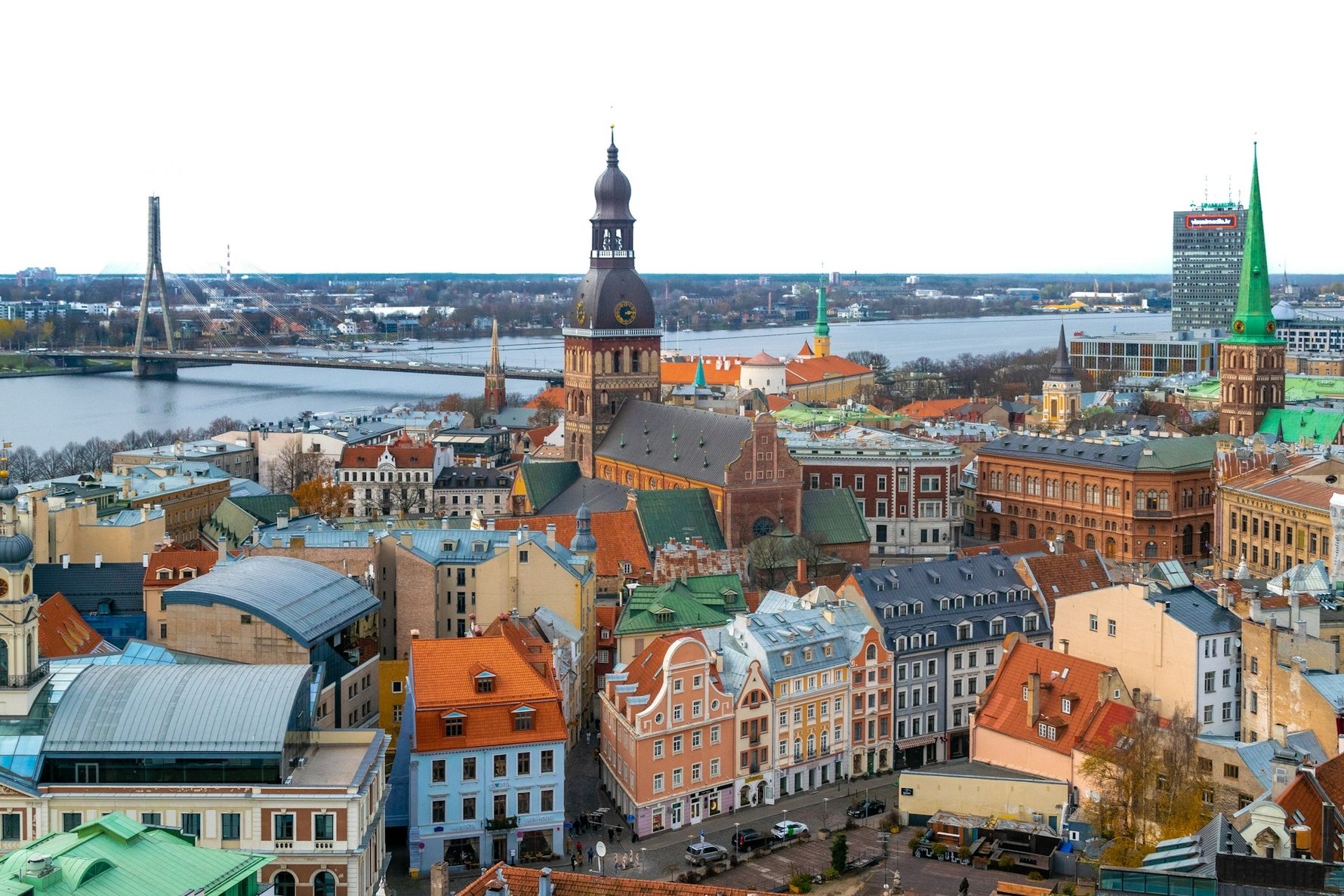
Old Riga was founded in 1201 by Bishop Albert of Riga, who was looking for a suitable base from which to Christianise the pagan peoples of the eastern Baltic, and who found it at a bend in the Daugava River that offered both strategic position and trade access. The city became a major member of the Hanseatic League and accumulated wealth, churches and merchant houses accordingly. The medieval core – now a UNESCO World Heritage Site since 1997 – has survived rather better than many of its contemporaries, partly because it was never entirely flattened and partly because the Soviets, despite their best efforts, could not rationalise everything. The street pattern is still medieval, and the mixture of Gothic, Baroque and Renaissance architecture gives the Old Town a layered quality that rewards slow exploration.
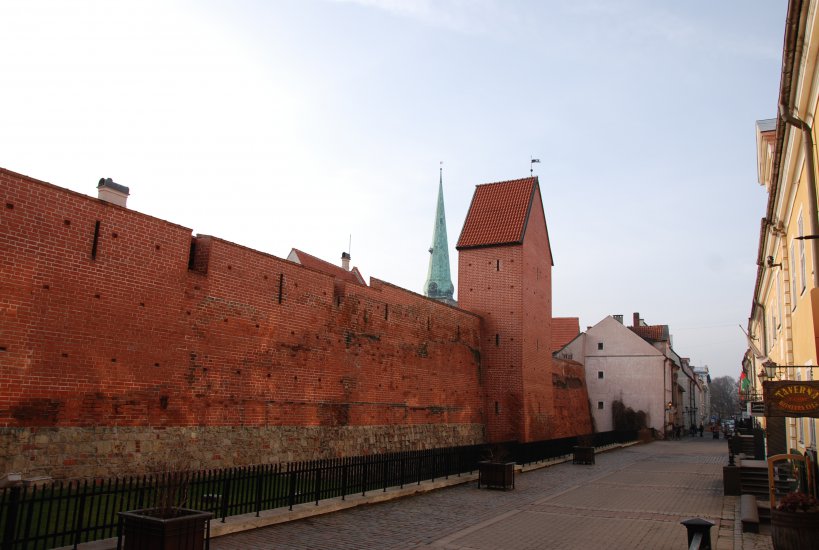
The essential landmarks are close together and walkable. The Three Brothers on Mazā Pils iela are the oldest surviving residential complex in the city: three houses built in different centuries (the oldest around 1490, in Late Gothic; the middle in Dutch Mannerist style; the youngest in Baroque), standing side by side as a small timeline of Riga’s architectural development. The Swedish Gate, built into the city wall in 1698, is the only surviving gate of the medieval fortifications. The Powder Tower, a 14th-century defensive tower now housing the Latvian War Museum, is the only remaining tower of the original city walls. And the Cat House – a yellow Art Nouveau building on Meistaru iela topped with two wrought-iron cats, tails raised, famously positioned to face the Great Guild Hall across the street – is the subject of a story about a rejected merchant and a grudge that should not be examined too closely for historical accuracy but makes for an excellent tour guide anecdote.
Location: The Old Town occupies the southwestern part of central Riga, between the Daugava River and the City Canal. It is a ten-minute walk from the central train and bus stations.
Best time to visit: Any time, though summer weekends bring considerable crowds to the main squares. Weekday mornings are ideal. The Christmas market, held in Town Hall Square from late November, is worth the cold.
Ticket prices: Free to walk. Individual attractions charge separately.
Good to know: The Latvian War Museum in the Powder Tower is free and covers Latvia’s military history from the medieval period to independence. The Museum of the History of Riga and Navigation in the Cathedral Cloister is the most comprehensive introduction to the city’s past. Both are worth an hour.
2. Riga Cathedral (Doma Bazñīca)
The Riga Cathedral was founded in 1211 by Bishop Albert, making it the oldest building in the city and, by most measures, the largest medieval church in the Baltic states. It has been modified so many times over eight centuries – Romanesque foundations, Gothic extensions, Baroque additions, Art Nouveau detailing – that architectural historians use it as a textbook illustration of how a building accumulates the styles of successive eras without ever quite settling on one. During the Soviet occupation, religious services were banned and the cathedral was pressed into service as a concert hall, a repurposing that at least preserved the building and, as it turned out, was not an entirely unsuitable use for it.
The reason for the latter is the organ, built by the German firm E.F. Walcker & Sons between 1882 and 1883 and inaugurated on 31 January 1884. At the time of its completion it was the largest organ in the world. It now has 6,718 pipes across four manuals and a pedalboard, and is widely considered one of the finest instruments in Europe. Franz Liszt composed a piece for the inauguration. The cathedral continues to hold regular organ concerts – checking the programme and attending one is rather more rewarding than a brief look around during the day. The Romanesque cloister attached to the cathedral is covered by the same ticket and contains the Museum of the History of Riga and Navigation, whose collection includes fragments of the city’s medieval past.
Location: Doma laukums 1, Rīga (Cathedral Square, Old Town)
Best time to visit: Attend an organ concert if at all possible. Check the schedule at doms.lv. The cathedral is less crowded early morning and late afternoon.
Ticket prices: Around €3–5 for the cathedral and cloister; organ concerts are priced separately. Check doms.lv for current prices and concert listings.
Good to know: The cathedral floor is visibly lower than the surrounding square – the result of centuries of subsidence as the city has grown around it. This is more interesting than it sounds once you notice it.
3. House of the Blackheads
The House of the Blackheads is the most-photographed building in Riga and, depending on your position on the reconstruction question, either one of the finest Gothic-Dutch Renaissance facades in the Baltic region or an extremely convincing reproduction of one. The Brotherhood of the Blackheads was a guild of unmarried foreign merchants, primarily German, who built themselves a meeting and banqueting house on Town Hall Square in 1334 and occupied it until the Soviet authorities dissolved the Brotherhood in 1940. The building was destroyed by German bombardment in 1941, the ruined walls were demolished by Soviet decree in 1948, and after independence the city of Riga rebuilt it between 1996 and 1999, based on pre-war photographs, architectural drawings and the one surviving original element: a medieval cellar buried under the ruins, which is now part of the museum.
The Brotherhood claimed credit for erecting the first decorated Christmas tree in history, in Riga in 1510 – a claim that the city’s tourism marketing has adopted with appropriate enthusiasm. The organisation was named after its patron saint, Maurice, who was depicted as a North African Moor; a figure of him in armour stands at the right-hand pillar of the entrance. An inscription on the building reads: “Should I ever crumble to dust, rebuild my walls you must”, which either reflects medieval sentiment or was added by later restorers who knew what was coming. Either way, it was heeded.
Location: Rātslaukums 7, Rīga (Town Hall Square, Old Town)
Best time to visit: Weekday mornings, before the square fills with tour groups. The façade is illuminated at night and worth seeing after dark.
Ticket prices: Around €7–8. The medieval cellar, the silver collection and the grand ballrooms are included. Check melngalvjunams.lv for current prices.
Good to know: The Latvian president used the building as a temporary presidential residence from 2012 to 2016 while Riga Castle underwent renovation. This did not appear to cause any particular awkwardness.
4. Alberta Street and Art Nouveau Riga
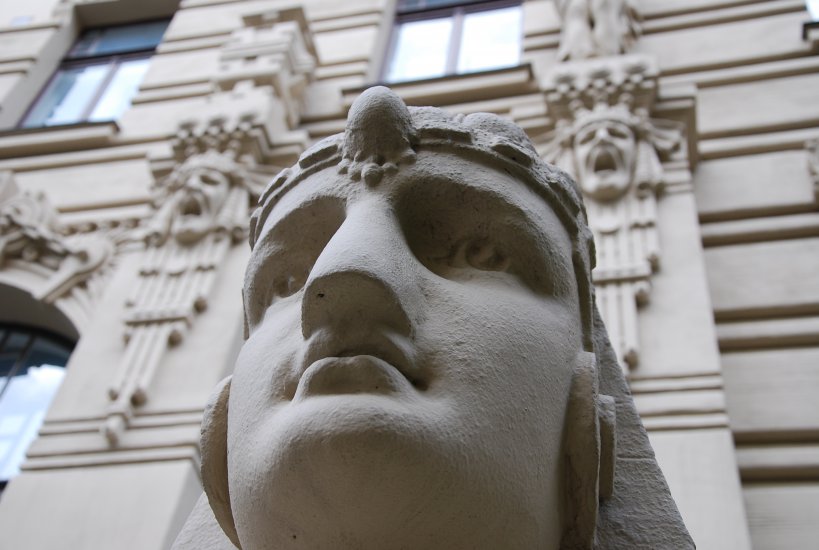
Between 1899 and 1914, more than 800 buildings in the Art Nouveau style were constructed in Riga, transforming the city’s expanding residential districts into what is now the largest and densest concentration of Art Nouveau architecture in the world. The economic conditions were right: Riga was booming as one of the most prosperous cities in the Russian Empire, a generation of ambitious young architects had trained in European schools and returned with new ideas, and there was money and appetite for the decorative exuberance that Art Nouveau permitted. The buildings that resulted – with their organic facades, mythological figures, screaming faces, writhing serpents, floral stucco and dramatically coloured exteriors – are unlike anything else in northern Europe.
Alberta iela is the showpiece: a short street built almost entirely between 1901 and 1908, largely by the architect Mikhail Eisenstein – father of the Soviet filmmaker Sergei Eisenstein – whose buildings here represent the most extravagant end of the style. Alberta iela 2a, where the philosopher Isaiah Berlin lived as a child from 1905 to 1915, is typical of Eisenstein’s approach: an explosion of ornamental detail that competes aggressively with its neighbours. The Riga Art Nouveau Museum at Alberta iela 12, a restored early 20th-century apartment, provides the interior context that the street facades alone cannot. Elizabetes iela, running parallel, contains further excellent examples; Strelnieku iela adds more.
Location: Alberta iela is a ten-minute walk north of the Old Town. The Riga Art Nouveau Museum is at Alberta iela 12.
Best time to visit: The museum is open Tuesday to Sunday. The street itself is best visited in morning light when the facades are most dramatic. A guided walking tour is the most efficient way to cover the main examples across Alberta, Elizabetes and Strelnieku streets.
Ticket prices: Free to walk the streets. The Art Nouveau Museum charges around €7. Check jgm.lv for current hours and prices.
Good to know: Over 750 of the original Art Nouveau buildings survive and form part of the UNESCO-listed Historic Centre of Riga. The concentration means that virtually any walk through the residential districts north of the Old Town will encounter examples, some of them in considerably better condition than others.
5. The Freedom Monument
The Freedom Monument stands 42.7 metres tall at the junction of Brīvības bulvāris and Rāina bulvāris, exactly where a bronze equestrian statue of Peter the Great once stood. It was unveiled on 18 November 1935, funded entirely by public donation, and designed by the sculptor Kārlis Zāle – the same man responsible for the Brothers’ Cemetery monument – who won the commission from a series of design competitions held between 1922 and 1930. A copper figure of Liberty crowns the obelisk, raising three gilded stars that represent Latvia’s three historical regions of Kurzeme, Vidzeme and Latgale. The inscription at the base reads: “Tēvzemei un Brīvībai” – For the Fatherland and Freedom.
The Soviet authorities considered demolishing it after the occupation of 1940 and eventually decided the public reaction would be too dangerous. Instead, they reinterpreted the three stars as representing the three Baltic Soviet Republics, which the local population declined to find convincing. Any gathering at the monument was strictly forbidden throughout the Soviet period. In the late 1980s, as the independence movement gathered force, it became the natural focal point for rallies; by 1990 Latvia had declared independence. A two-man honour guard from the National Armed Forces stands at the base between 09:00 and 18:00, changing every hour. A popular local joke during the Soviet years was that the monument doubled as a travel agent, since laying flowers at its base guaranteed a one-way ticket to Siberia.
Location: Brīvības bulvāris, Rīga (at the junction with Rāina bulvāris, on the edge of the Old Town)
Best time to visit: Any time. The guard-changing ceremony on the hour is brief and worth watching. The monument is especially atmospheric on 18 November (Latvian Independence Day) and 4 May (Restoration of Independence Day), when it becomes the centre of national ceremonies.
Ticket prices: Free.
Good to know: Bastejkalns Park, immediately behind the monument along the City Canal, is one of the best green spaces in central Riga and a good place to sit after the Old Town. The Barricades Memorial nearby commemorates the January 1991 events when Latvians built barricades to protect key buildings against Soviet military action.
6. Riga Central Market
In 1916, the German Imperial Navy built two enormous Zeppelin hangars at Vaiñode, a military air base in western Latvia, from which airships made reconnaissance flights over the Gulf of Riga and bombed Russian positions. The hangars were named Walhalla and Walther. After the German defeat in 1918 and Latvian independence in 1919, the hangars became available. In 1922, Riga City Council decided that the city needed a larger market and that the hangar roof structures should be used to build it. Construction ran from 1924 to 1930; when the Riga Central Market opened, it was immediately recognised as the largest and most modern market in Europe. It remains the largest covered market on the continent, and has been part of the UNESCO World Heritage Site since 1998.
The five pavilions – meat, fish, dairy, vegetables, and a general goods hall – are still the market’s organising principle, though the outdoor stalls and surrounding streets have expanded considerably around them. Around 80,000 people visit daily. The fish pavilion, where fresh Baltic catch is laid out on ice under the vaulted hangar arches, is the place to start: the smoked fish, particularly the eel and the sprats, is exceptional. The cheese and dairy section is the second stop. The produce stalls outside, where farmers sell seasonal goods at prices aimed at locals rather than tourists, are the third. The fried herring with cottage cheese at Sil&kcaron;ītes un Dillītes is frequently cited as the best introduction to Latvian food available in the city.
Location: Nēgīu iela 7, Rīga (adjacent to the central train and bus stations, a ten-minute walk from the Old Town)
Best time to visit: Morning, when the produce is freshest. Avoid the first Monday of the month when the pavilions close for a sanitary day.
Ticket prices: Free to enter.
Good to know: The market is open daily, though Sunday hours are shorter. The area immediately east of the market – the Maskavas forštate district, historically Riga’s Jewish quarter – is worth a brief detour for the atmosphere, which has a distinctly different character from the Old Town.
7. St Peter’s Church
First mentioned in records in 1209, St Peter’s Church is one of the oldest buildings in Riga and the one whose spire most defines the city’s skyline. The tower, first completed to a height of 136 metres in 1491, has been destroyed and rebuilt more times than seems fair: it collapsed in 1666, burned in 1677, was struck by lightning in 1721, and was destroyed by German artillery fire in 1941. Each time it was rebuilt; on its completion in 1690 the Baroque wooden tower was the tallest wooden structure in Europe. When the builders finished reconstructing it in 1973, they repeated a tradition from 1491: a worker hurled a glass from the top to predict the tower’s longevity, with more shards meaning more years. In 1491 a pile of straw had cushioned the fall; in 1973 the glass shattered satisfactorily.
The current tower, reconstructed in steel, is 123.25 metres tall. An elevator takes visitors to the observation platform at 72 metres, from which the red rooftops of the Old Town, the Daugava River, the surrounding Art Nouveau districts and, on clear days, the Gulf of Riga are all visible in a 360-degree panorama. The interior of the church – Lutheran since 1523, relatively austere as a result – holds the original 17th-century rooster weather vane from the tower, along with exhibitions and, periodically, concerts that make excellent use of the Gothic acoustics.
Location: Skarñu iela 19, Rīga (Old Town)
Best time to visit: Morning for the viewing platform (the elevator queue builds through the day). The church plays the Latvian folk melody “Rīga dimd” from the tower five times daily; it sounds better from outside than from the observation platform.
Ticket prices: Around €9 for the church and tower combined. Church only around €3. Closed Mondays. Check peterbaznica.riga.lv for current hours.
Good to know: The clock on the tower has only one hand, following an old tradition. This is not a malfunction.
8. Museum of the Occupation of Latvia
The Museum of the Occupation of Latvia occupies the bleak black building on Town Hall Square that was originally built to house an exhibition glorifying the Latvian Red Riflemen, a unit of the Soviet army; after independence, the building was rather pointedly repurposed. The museum covers Latvia’s two occupations: Soviet from 1940 to 1941 and again from 1944 to 1991, and Nazi German from 1941 to 1944. The two are presented without false equivalence but with the same documentary rigour: the deportations to Siberian gulags, the mass murders of the Jewish population, the resistance movements, the daily life of Latvians under each regime, and the eventual road back to independence. It is one of the most clearly organised and emotionally affecting occupation museums in the Baltic region, and it is free.
The museum is small but dense: two floors of material that requires genuine attention rather than a quick pass-through. The section on the deportations – Latvia lost roughly a third of its population to deportation, flight and murder between 1940 and 1945 – is the most affecting, partly because of the personal testimonies and partly because the scale is impossible to absorb quickly. The section on Soviet daily life, covering the decades from 1944 to 1991, provides context for the independence movement that is essential for understanding modern Latvia. Allow ninety minutes at minimum; two hours is not excessive.
Location: Strēlnieku laukums 1, Rīga (Town Hall Square, Old Town)
Best time to visit: Weekday mornings when it is least crowded. The museum requires sustained concentration and benefits from a quieter visit.
Ticket prices: Free. A donation is suggested and merited.
Good to know: The museum is currently housed in a temporary building while a permanent facility is being constructed nearby. Check occupationmuseum.lv for current opening hours and location details before visiting.
9. Latvian Ethnographic Open-Air Museum
The Latvian Ethnographic Open-Air Museum is 13 kilometres northeast of the Old Town, on 87 hectares of pine forest beside Lake Jugla, and it is one of the oldest and largest open-air museums in Europe. Founded in 1924, it was modelled on Skansen in Stockholm – the idea being to gather representative traditional buildings from all four of Latvia’s historical regions before they disappeared, dismantle them carefully, transport them to the site, and reassemble them as a living record of Latvian rural life. The collection now stands at 118 buildings: farmhouses, granaries, windmills, smokehouses, wooden churches, a Livonian fishing village, a Latgale Old Believers’ homestead, a blacksmith’s forge, a weaver’s workshop. Most date from the 17th century to the 1930s and are furnished with original tools and household equipment.
The particular advantage of the museum over similar institutions elsewhere is that it began collecting before the war, when many objects were still in everyday use rather than already in storage. The quality and authenticity of the collection reflects this. Between May and September, resident craftspeople – potters, weavers, blacksmiths, woodworkers – work in the buildings using traditional methods, which transforms the experience from a heritage walk into something closer to an actual glimpse of rural Latvian life. The annual traditional craft fair, held every summer since 1971, is the museum’s largest event and draws tens of thousands of visitors.
Location: Brīvdabas muzeja iela 440, Rīga. Bus 1 from the city centre to the Brīvdabas muzejs stop; around 30–40 minutes.
Best time to visit: Between May and September when the craftspeople are in residence and the grounds are at their most pleasant. The museum is also open in winter, when the snowed-over farmsteads have a particular atmosphere.
Ticket prices: Around €6–8. Check brivdabasmuzejs.lv for current prices and event listings.
Good to know: Allow at least three hours; four is more realistic if you want to see everything. The on-site pub serves traditional Latvian food including grey peas with bacon and rye bread, which are the correct things to eat.
10. Riga Motor Museum
The Riga Motor Museum sits in the northern suburbs of the city, far enough from the Old Town that most visitors who intend to go never quite get there, which is a significant planning error on their part. The collection of around 100 vehicles covers the history of the automobile from its earliest days, includes a range of pre-war European sports and racing cars, and features an authentic replica of the 1938 Auto Union V16 Type C/D racing car that was the museum’s founding obsession – the original having been discovered as a wreck in Moscow, sold to fund the museum, and replaced with a copy built to the original specifications. None of this is the reason to come.
The reason to come is the Kremlin Collection: a group of cars used by Soviet leaders, acquired by the museum while the USSR was still operating and therefore of a documentary authenticity that is now irreplaceable. Stalin’s 1949 ZIS-115 armoured limousine – which was undergoing bulletproof tyre tests when he died in 1953, and was subsequently forgotten at the factory until it was rescued – is the centrepiece, complete with a wax figure of Stalin in the back seat. Leonid Brezhnev’s 1966 Rolls-Royce Silver Shadow, which he crashed personally in 1980, is displayed exactly as it appeared after the accident, also with a wax Brezhnev at the wheel. A Lincoln Continental given to Brezhnev by President Nixon in 1973 is nearby. The overall effect is a precise and rather funny record of how a society that preached equality actually lived at the top.
Location: S. Ērtiņa iela 6, Rīga. Buses 5 and 15 from the centre; around 20–30 minutes.
Best time to visit: Any time. The museum is well-organised and not usually crowded. Allow at least two hours.
Ticket prices: Around €10–12. Check motormuzejs.lv for current prices.
Good to know: Stalin’s limousine consumed a litre of petrol every 2.5 kilometres. This is not mentioned on the label but is noted by Lonely Planet, who clearly felt it was the most important single fact about the vehicle, and they are probably right.
What else is there to see in Riga?
Riga’s Old Town contains more than the ten above could cover. The Latvian National Museum of Art, in a monumental Art Nouveau building just north of the Old Town on Kr. Valdemāra iela, holds the largest collection of Latvian art from the 18th century to the present and reopened after major renovation in 2016 in considerably improved form. The Latvian National Opera, on Aspazijas bulvāris since 1923, runs a season of opera and ballet from September to May of genuine European quality – the building alone, a white neoclassical structure beside the City Canal, is worth the walk past. The Nativity of Christ Cathedral, the Russian Orthodox cathedral on Brīvības bulvāris, is a neo-Byzantine structure of some grandeur that spent the Soviet period as a planetarium and then a café, which represents two of the more creative occupational uses of a cathedral on record.
Across the river from the Old Town, the left bank of the Daugava offers a different perspective on the city. The National Library of Latvia, opened in 2014 and designed by the Latvian-American architect Gunārs Birkerts as a mountain of glass books rising above the water, is the most architecturally significant building constructed in Latvia since independence. The Kalnciema Quarter, a restored 19th-century wooden house district a few tram stops south, hosts a Saturday market that is the best place in the city for locally produced food and is attended almost exclusively by people who actually live in Riga. For day trips, Sigulda in the Gauja National Park is an hour east by train and has a castle, a medieval cave complex, a cable car and, in winter, a bobsled track that members of the public can ride, which is either enormously appealing or the last thing you want to know about.