Dublin is a city that wears its history lightly and its literature heavily. This is a place where you can stand in a pub that has been operating since the 17th century, drink a stout that has been brewed since 1759, and have an argument about James Joyce within five minutes of arriving – none of which requires any particular effort. The city is compact, walkable, and relentlessly sociable, and the major sights are genuinely major rather than merely well-marketed. Ireland's complicated relationship with its colonial past gives everything here an edge that more peaceable histories cannot quite produce. Prices below were correct at time of writing; always worth a check before you visit.
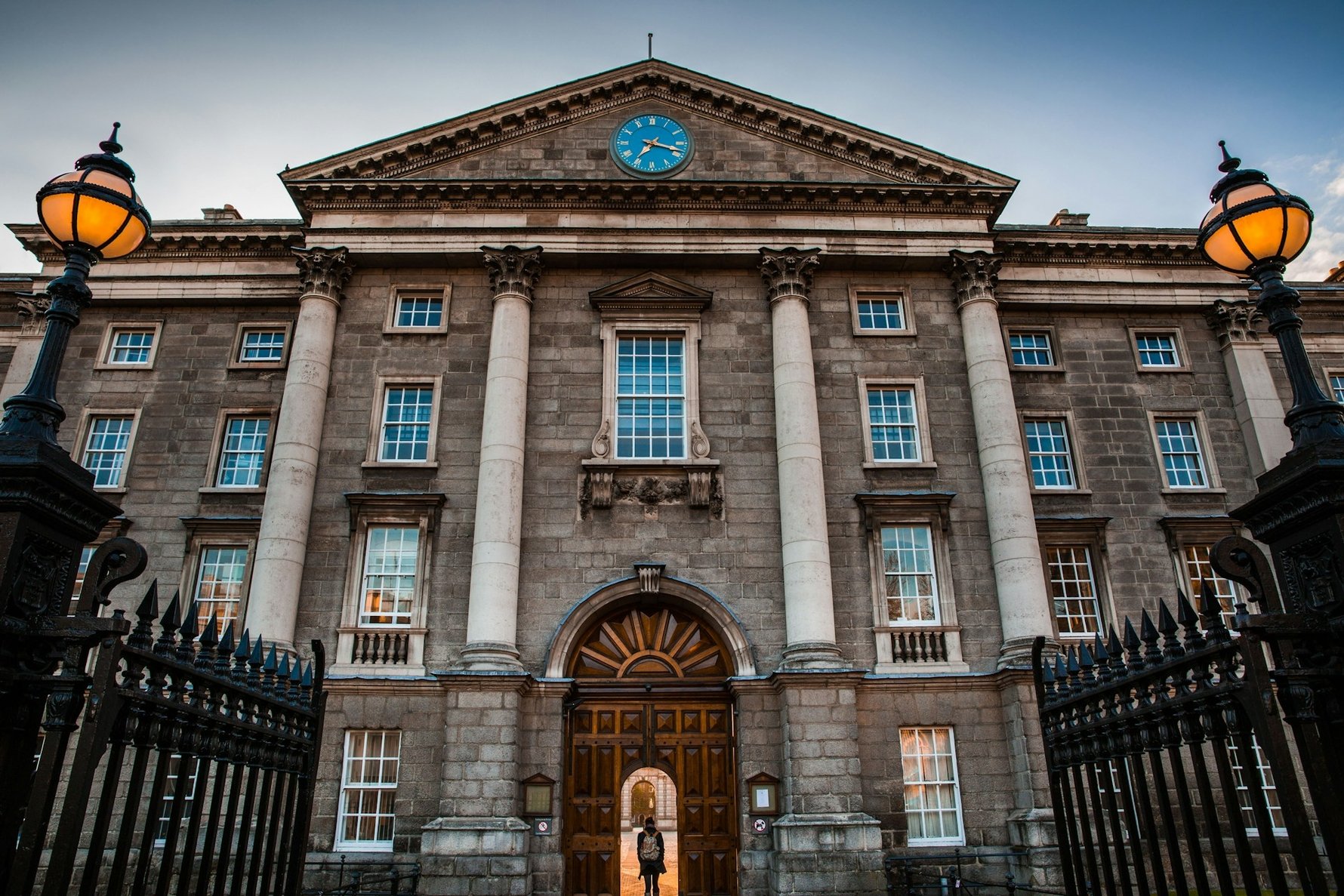
Trinity College Dublin was founded in 1592 by Elizabeth I, ostensibly to bring higher education to Ireland but primarily, as the college's own historians acknowledge, to strengthen Protestant and English influence in a stubbornly Catholic country. It remained closed to Catholics until 1793, and the Catholic Church banned its members from attending until 1970, which gives the institution a complicated heritage that the current student body navigates with varying degrees of interest. The campus itself is one of the finest in Europe: thirty-five acres in the heart of the city, Georgian squares, a cobbled Parliament Square with the campanile at its centre, and the Long Room library that George Lucas visited and then publicly denied using as inspiration for the Jedi Archives in Star Wars: Episode II. The denial is not widely believed.
The Book of Kells is an illuminated manuscript of the four Gospels created by Celtic monks around AD 800, probably on the island of Iona before being brought to Ireland for safekeeping during Viking raids. It arrived at Trinity in 1661 and has been drawing visitors ever since. Only two pages are displayed at a time; what you see depends on when you visit. The Long Room – a 65-metre barrel-vaulted library holding over 200,000 of the oldest books in the collection, marble busts of philosophers and scholars, and the 15th-century Brian Boru harp that is the model for the Irish national symbol – is visitable as part of the same ticket. A significant conservation project currently has the Long Room's shelves almost entirely cleared of books, which will be the situation until at least 2027–2030. The room itself remains open and is still worth seeing; plan accordingly.
Location: College Green, Dublin 2. Front gate on Dame Street; a ten-minute walk from O’Connell Bridge.
Best time to visit: Arrive at opening time. Timed tickets are essential; book online well in advance at visittrinity.ie as popular slots sell out. The campus itself is free to walk around.
Ticket prices: Around €23 for the Book of Kells Experience including Long Room access. Check visittrinity.ie for current prices, as a major digital exhibition has been added alongside the traditional visit.
Good to know: A copy of the 1916 Proclamation of the Irish Republic is kept in the Long Room, with the typographical inconsistencies caused by running out of matching type during a clandestine midnight print run clearly visible. This is a better story than the Book of Kells.
2. Dublin Castle and the Chester Beatty Library
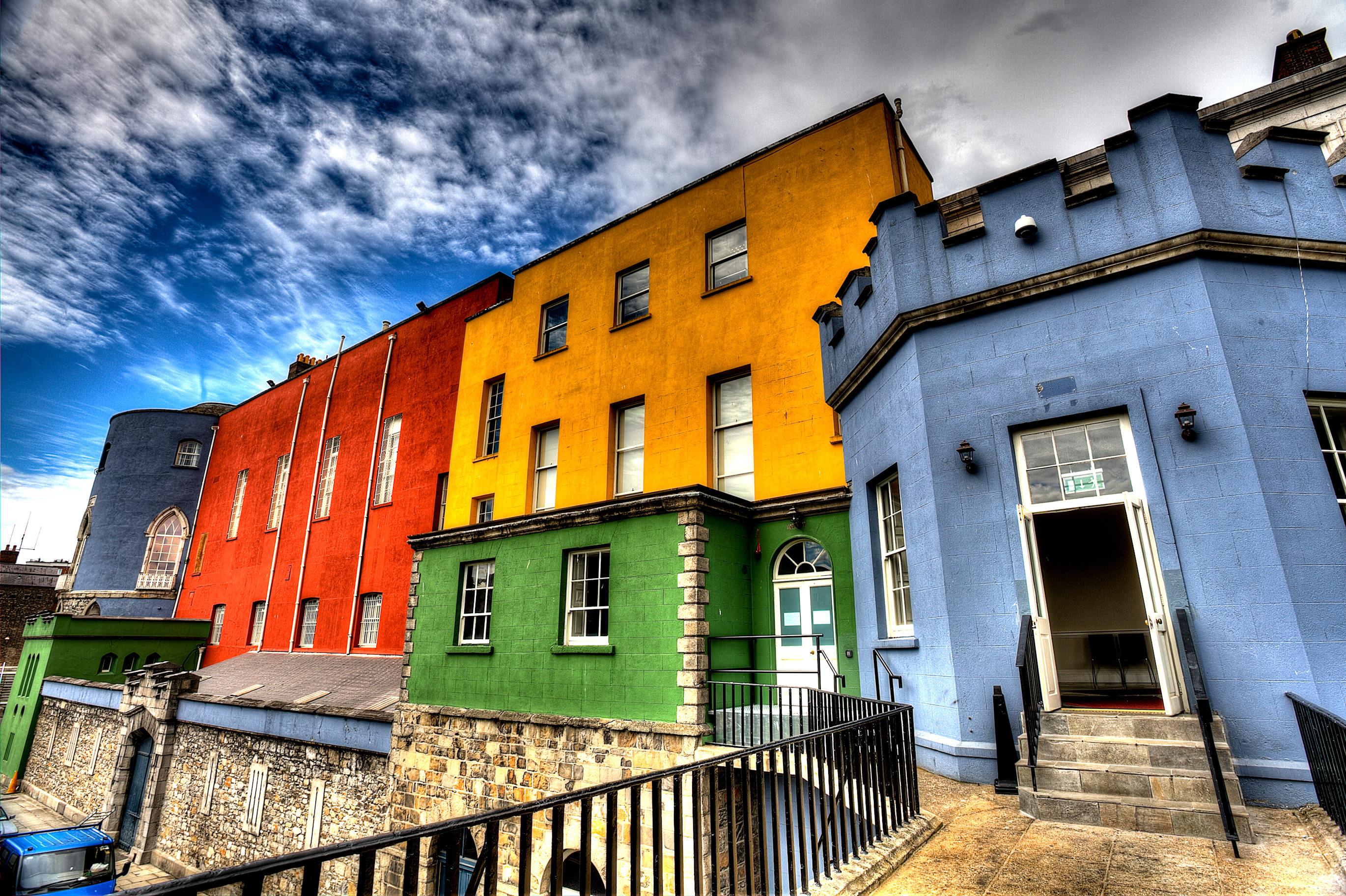
Dublin Castle was built in 1204 on the orders of King John and served as the seat of British rule in Ireland for the following 718 years, making it the most significant single site in the history of Irish subjugation. The handover to the new Irish Free State government took place here in January 1922; according to one account, the outgoing British Viceroy arrived slightly late, prompting Michael Collins to remark that he was seven minutes late but the English had been seven hundred years late in getting out. Whether Collins said this is disputed. The sentiment was not. The sprawling complex now serves as a government conference centre, a museum, and the site of the presidential inauguration every seven years; the State Apartments, where the Lord Lieutenants of Ireland once entertained on a lavish scale, are the main visitor draw.
The Chester Beatty Library, in the castle grounds, is one of the finest museums in Europe and is free. Sir Alfred Chester Beatty was an American mining magnate who spent his fortune acquiring manuscripts, books, prints and objects from across the Islamic world, East Asia and the West, bequeathed the collection to Ireland on his death in 1968, and was made the country’s first honorary citizen in gratitude. The collection includes papyrus fragments from Egypt dating to 1500 BC, illuminated Qur’ans, Japanese woodblock prints, Mughal miniatures and early Western manuscripts of a quality that causes serious scholars to make special journeys. It won European Museum of the Year in 2002, was named Ireland’s favourite museum on multiple occasions, and is still somehow undervisited relative to its quality. Admission is free. There is no good reason not to spend two hours here.
Location: Dame Street, Dublin 2 (main entrance). Chester Beatty Library entrance via Ship Street Gate. A five-minute walk from Trinity College.
Best time to visit: Check dublincastle.ie before visiting – Ireland’s EU Council Presidency from mid-2026 will close the castle campus entirely to the public for an extended period. The Chester Beatty Library has its own opening hours (closed Mondays) and remains one of the most reliably good museum visits in the city regardless of the castle’s state.
Ticket prices: State Apartments: guided tour around €12, self-guided around €8. Chester Beatty Library: free.
Good to know: The Great Courtyard of the castle is the reputed site of the Dubh Linn, or Black Pool, from which Dublin takes its name. The medieval undercroft beneath the castle contains the remains of a Viking-era cobblestone road.
3. Kilmainham Gaol
No site in Ireland carries quite the weight of Kilmainham Gaol. Built in 1796, the prison held the leaders of every major Irish rebellion from the United Irishmen of 1798 through to the Civil War of 1922–23, which means it contains within its walls something close to a complete record of the Irish struggle for independence. Charles Stewart Parnell was imprisoned here. Robert Emmet was held here. After the Easter Rising of 1916, the British authorities transferred the surviving leaders here, tried them in secret courts martial, and shot fourteen of them by firing squad in the Stonebreaker’s Yard between 3 and 12 May – Patrick Pearse, James Connolly, Thomas Clarke and eleven others. The executions, particularly that of Connolly, who was so badly wounded he had to be strapped to a chair, turned public opinion in Ireland decisively against British rule. It is not an exaggeration to say that what happened in this yard made Irish independence inevitable.
The gaol closed in 1924, fell into disrepair, and was restored by volunteers from the 1960s onward before opening as a museum in 1966. The guided tours – the only way to see the main areas – are among the most compelling museum experiences in Ireland, partly because the guides are excellent and partly because the building itself is extraordinary: the Victorian east wing, a panopticon of iron galleries and glass ceiling, is one of the most photographed interiors in the country. Joseph Plunkett married Grace Gifford in the chapel the night before his execution; her mural of the Madonna on her own later cell wall can still be seen.
Location: Inchicore Road, Kilmainham, Dublin 8. A 30-minute walk from the city centre, or bus routes 13, 40, 123 from the quays.
Best time to visit: Guided tours run at set times and sell out; book well in advance at kilmainhamgaolmuseum.ie. Tours last around an hour.
Ticket prices: Around €9 for adults. Free for under-12s. Check kilmainhamgaolmuseum.ie for current prices and booking.
Good to know: The Irish Museum of Modern Art (IMMA) is adjacent to the gaol, in the extraordinary 17th-century Royal Hospital Kilmainham building – one of the finest classical buildings in Ireland and a museum of genuine quality. Allow time for both.
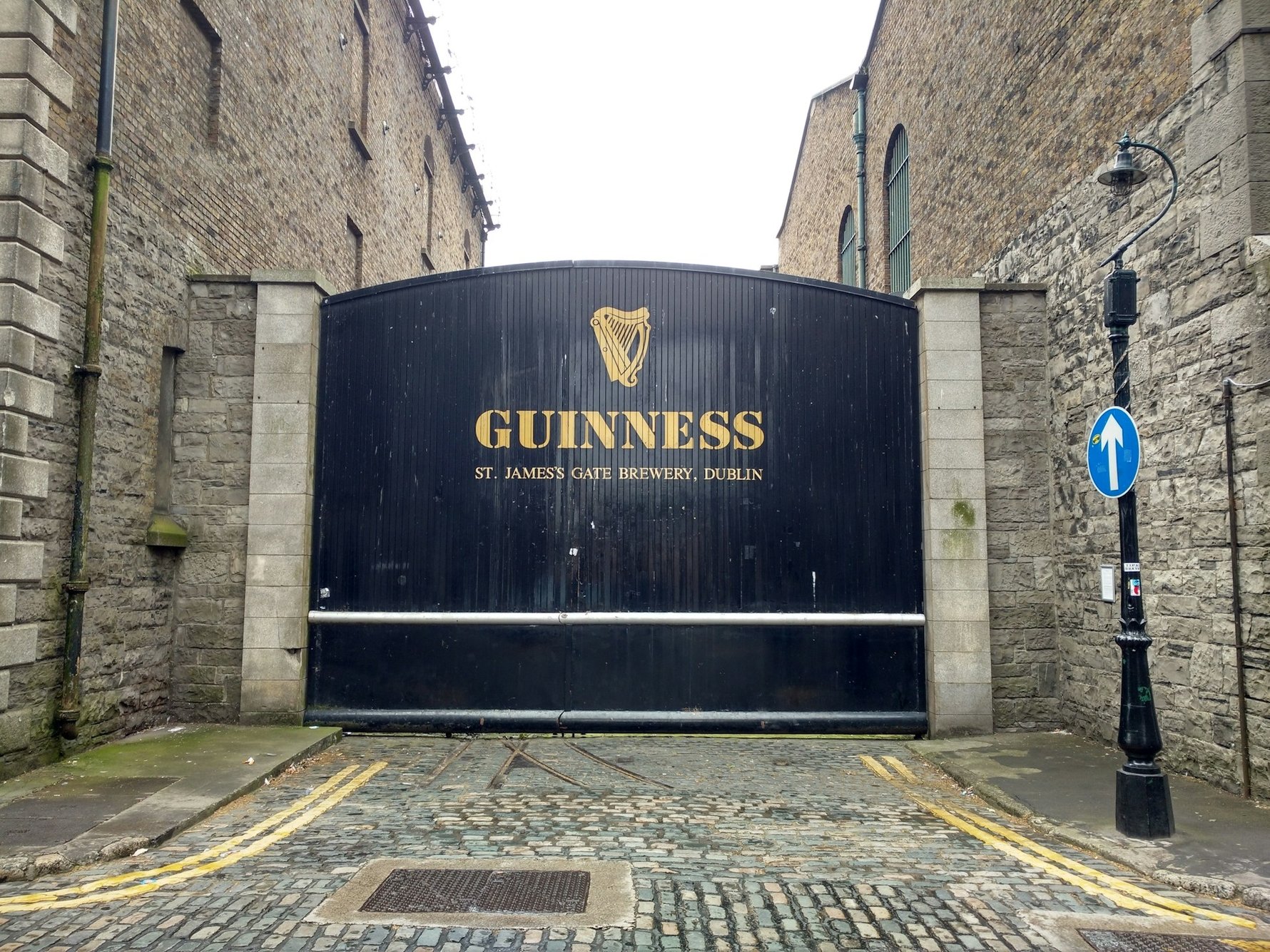
Arthur Guinness signed a 9,000-year lease on the St James’s Gate brewery site in 1759 for an annual rent of £45, which is either the best or the most presumptuous piece of commercial planning in the history of the beverage industry, depending on your view. The Guinness Storehouse, a converted 1904 fermentation plant built in the Chicago School style and the first steel-framed multi-storey building in Ireland, opened as a visitor attraction in 2000 and has since received over twenty million visitors, making it consistently the most visited paid attraction in the country. The building’s central atrium is designed in the shape of a pint glass; if it could be filled, it would hold 14.3 million pints, which is information the marketing department considers important.
Seven floors cover the history of Guinness, the brewing process, the advertising (genuinely fascinating – the Guinness campaigns from the 1930s to the 1980s are some of the most inventive in British and Irish commercial history), and the mechanics of the perfect pour. The Gravity Bar at the top, 46 metres above street level, provides the most panoramic 360-degree view of Dublin available anywhere in the city and includes a complimentary pint in the ticket price. The view runs from the Dublin Mountains to the south to Howth Head to the north, with the entire Georgian city spread below. It is not a subtle experience, but it is done well, and the view is genuinely the best in Dublin. Book tickets online; weekend sessions sell out.
Location: St James’s Gate, Dublin 8 (The Liberties). A 25-minute walk from the city centre along the quays, or Luas Red Line to James’s Street stop.
Best time to visit: Weekday mornings for fewer crowds. The Gravity Bar is most atmospheric in the evening, though crowds are heavier.
Ticket prices: Around €22–26 for general admission including one drink at the Gravity Bar. Book at guinness-storehouse.com; prices vary by time slot.
Good to know: The 9,000-year lease is on display on the ground floor. The Storehouse does not include a tour of the actual working brewery, which is a separate experience. The surrounding Liberties neighbourhood, Dublin’s oldest, is worth a walk before or after.
5. The National Museum of Ireland: Archaeology
The National Museum of Ireland – Archaeology on Kildare Street is free, takes under two hours to cover properly, and contains some of the finest early medieval and prehistoric objects in Europe. It is also, inexplicably, less busy than it deserves to be on almost every day of the year, which makes it one of the more pleasant museum experiences the city offers. The building itself, opened in 1890, is Victorian confidence made stone: a domed rotunda, mosaic floors, marble columns and an arrangement that has the distinct feeling of a place built to impress visitors with the seriousness of what is housed within it.
The Treasury holds the headline objects. The Ardagh Chalice, an 8th-century two-handled silver chalice decorated with gold filigree and enamel, is the centrepiece: 350 separate components, made by craftspeople of a technical sophistication that modern jewellers still study. The Tara Brooch, also 8th century, is decorated on both front and back with a density of ornament that requires a magnifying glass to fully appreciate, which the monks who made it evidently did not consider wasted effort. The prehistoric gold collection – lunulae, gorgets, sun discs from the Bronze Age – is the largest of its kind outside Egypt. The Kingship and Sacrifice exhibition centres on the bog bodies, Iron Age human remains preserved by the chemistry of peat bogs, several of whom show signs of ritual killing: multiple wounds, deliberate drowning, manicured fingernails. Cashel Man, displayed here, is the oldest fleshed bog body found anywhere in Europe at around 4,000 years old.
Location: Kildare Street, Dublin 2. Beside Leinster House, a five-minute walk from St Stephen’s Green.
Best time to visit: Any time – it is rarely crowded. Free guided tours run at set times; check museum.ie for the current schedule.
Ticket prices: Free.
Good to know: The Natural History Museum (the “Dead Zoo”), an unchanged Victorian natural history museum on Merrion Street two minutes away, is another free National Museum branch and a genuinely strange and wonderful place – the Victorian display cases are part of the attraction. The National Gallery of Ireland, also nearby on Merrion Square, holds a strong collection of Irish and European art and is also free.
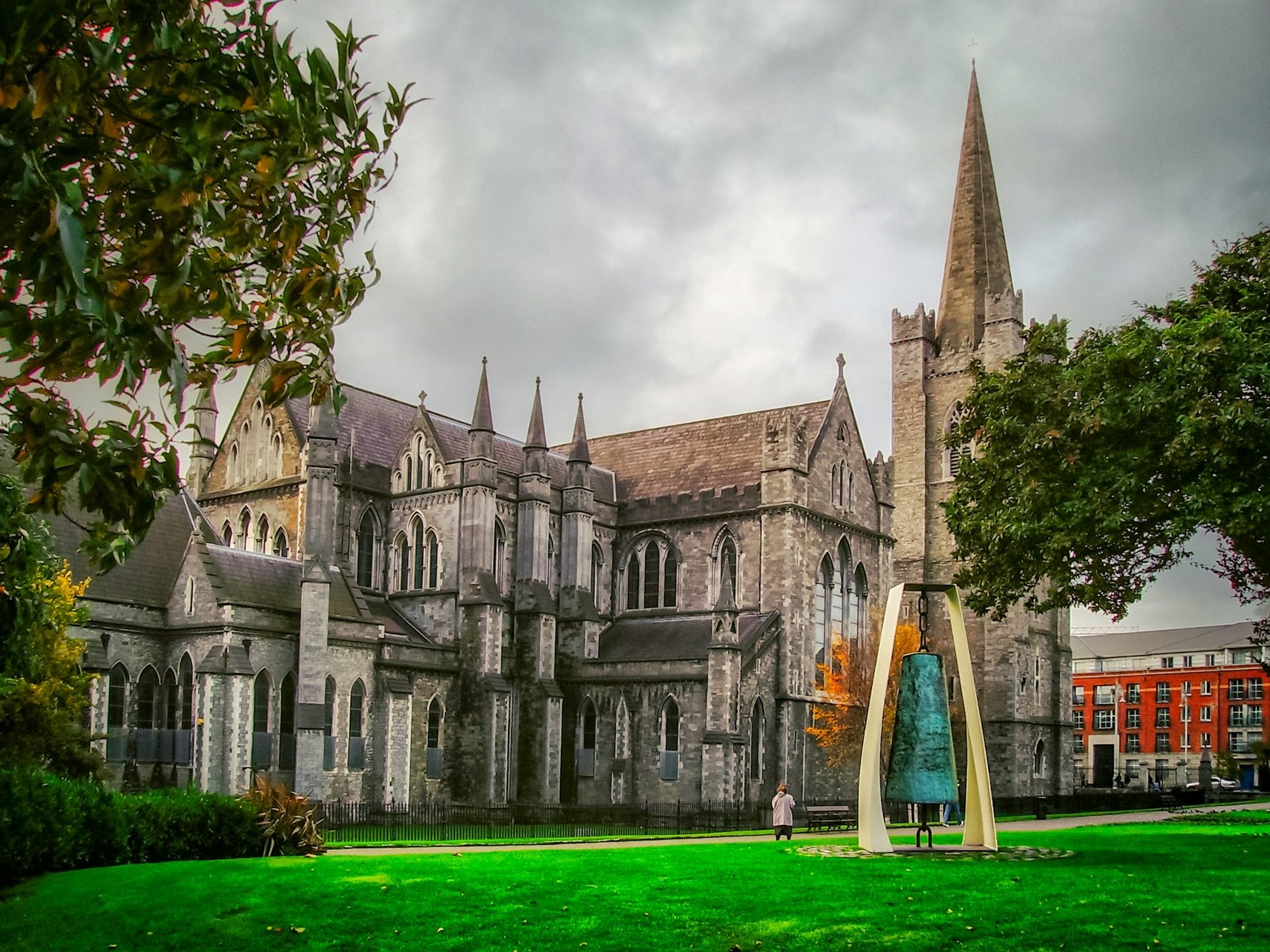
St Patrick’s Cathedral was built on the site of a well at which St Patrick reputedly baptised converts to Christianity in the 5th century, though the first stone church on the site dates from 1191 and the current structure from the 13th century. It is the largest church in Ireland, Church of Ireland (Protestant) since the Reformation, and has spent much of its history in a state of some tension with the nearby Christ Church Cathedral, which is technically the city’s other Protestant cathedral and with which St Patrick’s has contested precedence for several hundred years. The low point came in 1300, when the two chapters became so bitter about their dispute that their members engaged in open fighting in the streets. The dispute was eventually resolved; the street fighting, reportedly, was not immediately effective.
Jonathan Swift was Dean of St Patrick’s from 1713 to 1745, and the cathedral contains his grave, his death mask, his pulpit, and the epitaph he wrote for himself, translated from the original Latin by W.B. Yeats as “He has gone where fierce indignation can lacerate his heart no more.” Swift donated his entire estate to found a psychiatric hospital in Dublin – St Patrick’s Hospital, which is still operating – and wrote a satirical poem about the bequest that began “He gave the little wealth he had / To build a house for fools and mad.” His coat of arms and motto are on display in the nave. The interior is largely the result of a 19th-century restoration funded by Benjamin Lee Guinness, who spent £150,000 on it and whose statue stands outside in permanent gratitude.
Location: St Patrick’s Close, Dublin 8. A ten-minute walk from Dublin Castle, or bus routes 49, 54a from the city centre.
Best time to visit: Weekday mornings for quieter access. The cathedral holds regular services which temporarily close it to tourists; check stpatrickscathedral.ie for times.
Ticket prices: Around €8 for adults. Check stpatrickscathedral.ie for current prices. Free for worshippers attending services.
Good to know: The Liberties neighbourhood surrounding the cathedral – Thomas Street, Meath Street, the Coombe – is the oldest continuously inhabited part of Dublin and the least touristy. The walking works well as a connection between Kilmainham, St Patrick’s, Dublin Castle and Trinity, covering a substantial portion of the city’s history in a single route.
7. Merrion Square and Georgian Dublin
Dublin’s Georgian core, built largely in the second half of the 18th century, is one of the finest examples of planned urban architecture in Europe and a direct result of the Anglo-Irish Protestant Ascendancy’s enthusiasm for spending money on houses that announced their own importance. Merrion Square is its showpiece: a garden square surrounded on three sides by some of the finest Georgian townhouses in existence, the doors painted in competing colours of black, red, yellow and green, the fanlights above each entrance a small individual statement of decorative intent. The square is in private hands but the park at its centre is public. The southwest corner has Oscar Wilde reclining on a rock in polychrome stone, put there in 1997 and the most cheerful public sculpture in Dublin by a considerable margin.
Wilde was born at number 1 Merrion Square, then the home of his father Sir William Wilde, the city’s leading eye and ear surgeon, and his mother Jane, who wrote nationalist poetry under the pen name Speranza. Daniel O’Connell, the Liberator, lived at number 58. W.B. Yeats lived at numbers 52 and 82 at different points. The surrounding streets – Fitzwilliam Square, Lower Baggot Street, Pembroke Road – extend the Georgian fabric in a quality and quantity that Dublin rightly considers a significant part of its identity. The four sides of Merrion Square, facing out from the park, form one of the most consistently handsome urban streetscapes in these islands, and it is free to walk through at any hour.
Location: Merrion Square, Dublin 2. A ten-minute walk from Trinity College along Nassau Street.
Best time to visit: Any time. Sunday mornings, when the park railings host an outdoor art market (amateur and professional works for sale), is particularly good.
Ticket prices: Free. The National Gallery of Ireland on the west side of the square is also free.
Good to know: Number 29 Lower Fitzwilliam Street, a short walk away, is preserved and furnished as a late Georgian townhouse and gives the best interior impression of how these houses actually functioned. Small admission fee; check the National Museum website for opening hours.
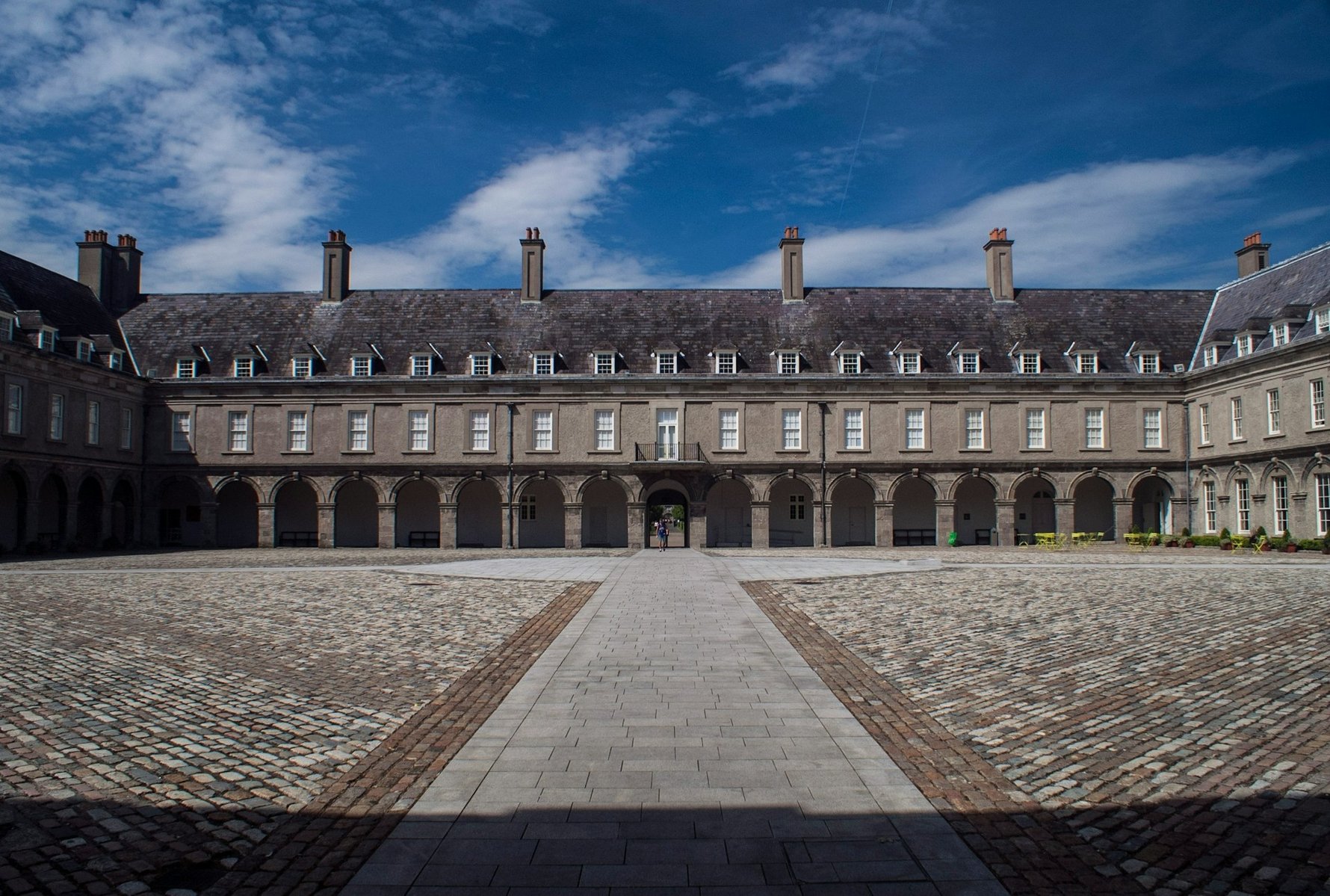
The Irish Museum of Modern Art (IMMA) is housed in the Royal Hospital Kilmainham, a building completed in 1684 as a home for veteran soldiers and the finest 17th-century building in Ireland by some distance. Its central courtyard, a formal quadrangle of arcaded stone with a chapel at one end, is of a quality that routinely causes first-time visitors to feel they have been misdirected into France. The museum itself opened in 1991 and holds a permanent collection of around 3,500 works, Irish and international, from the mid-20th century to the present, alongside a programme of temporary exhibitions that is consistently among the strongest in the country.
The permanent collection includes significant works by Louis le Brocquy, Sean Scully, Dorothy Cross, Gilbert & George, Marina Abramovič and Joseph Beuys, among others, and is displayed across a series of rooms that manage to feel both institutional and intimate. The temporary exhibition programme is IMMA’s strongest suit: major retrospectives of international figures alongside emerging Irish artists, with enough variety in the programming to reward repeat visits. The combination of the building, the gardens (formal on the south side, wildflower and walled on the north), and the collection makes IMMA the best full-afternoon museum experience in Dublin, and entry to most of the permanent collection is free.
Location: Military Road, Kilmainham, Dublin 8. Adjacent to Kilmainham Gaol; the two are natural companions for a single visit.
Best time to visit: Weekday afternoons for the galleries. The grounds are open daily and worth a walk regardless of whether you enter the museum.
Ticket prices: Permanent collection free; temporary exhibitions charge varies. Check imma.ie for current programme and prices.
Good to know: IMMA also functions as a venue for concerts and events. The summer programme in the garden is worth checking if you’re visiting between June and August.
9. Howth
Thirty minutes north of Dublin by DART, Howth is a fishing village on a rocky headland at the northern tip of Dublin Bay that functions as the city’s most accessible escape from itself. The DART drops you at the harbour, where grey seals bob alongside the fishing boats with the unimpressed air of animals who have decided that tourist attention is simply part of the deal. The cliff walk – five colour-coded routes ranging from a 2km summit stroll to a 12km full-headland loop – starts at the east end of the harbour and climbs through gorse and rhododendron to views that take in the full sweep of Dublin Bay, the Wicklow Mountains to the south, Ireland’s Eye island just offshore, and, on a good day, the Mourne Mountains in Northern Ireland to the north. James Joyce referenced Howth Head in the closing pages of Ulysses; the setting justifies the attention.
The fish and chips from the harbour restaurants are consistently cited as the best in greater Dublin. Beshoff Bros and Octopussy’s are the permanent fixtures; the queue on a sunny weekend afternoon tells you what you need to know. The Sunday market near the DART station sells bread, smoked fish, vegetables and handmade goods from local producers, and operates at the useful overlap between the genuinely local and the genuinely good. Ireland’s Eye, the small uninhabited island visible from the harbour, can be reached by boat and contains a Martello tower and a notable seabird colony; boat trips run from the harbour in summer.
Location: DART to Howth terminus from Connolly, Tara Street or Pearse stations; around 30 minutes. Trains run frequently throughout the day.
Best time to visit: A clear weekday to avoid weekend crowds on the cliff paths. Sunday morning for the market combined with a cliff walk. Arrive early on summer weekends; the harbour car park fills by 10am.
Ticket prices: DART fare only (around €6 return from the city centre). The cliff walk is free. Boat trips to Ireland’s Eye around €15 return.
Good to know: Howth Castle and its rhododendron gardens are at the western end of the village and impressive in late spring when the rhododendrons are in bloom. The castle itself is private.
10. The Liberties and the Old City
The Liberties – the area west of Dublin Castle bounded roughly by Thomas Street to the north and the Coombe and Meath Street to the south – was the industrial heart of Dublin from the medieval period through to the 20th century, home to weavers, tanners, brewers and distillers, and the most densely populated and frequently troubled area of the city. It is now in an intermediate stage of gentrification that has produced good independent restaurants, the redeveloped Newmarket Square, and a growing collection of studios and small shops alongside the original butchers, market traders and old pubs that have been here for generations. It is where Dublin stops performing for visitors and starts being itself.
The area rewards walking without a fixed plan more than almost anywhere else in the city. Thomas Street, where Robert Emmet was hanged in 1803, has the Roe & Co distillery in the old Powers whiskey building and the early medieval church of St Catherine at its junction with Meath Street. Meath Street itself leads down to the covered Iveagh Market building, long derelict, long promising redevelopment. Francis Street, the antique dealers’ street, is worth an afternoon. The flat-iron junction of Nicholas Street and Patrick Street, at the foot of the Christ Church Cathedral hill, is the site of the earliest Viking settlement in Dublin. Standing there is as close as the city currently gets to showing you its origins at street level.
Location: West of Dublin Castle and Christ Church Cathedral; walkable from the city centre. Luas Red Line to Four Courts or Smithfield for the northern edge.
Best time to visit: Weekday mornings for the market traders. Saturday for Newmarket Square. Any time for walking the streets.
Ticket prices: Free. The Roe & Co distillery runs tours and tastings at a modest charge.
Good to know: Vicar Street, on Thomas Street, is one of the best medium-sized live music venues in Ireland and worth checking the programme for if you’re in town for more than a night.
What else is there to see in Dublin?
The National Gallery of Ireland on Merrion Square West holds the national collection of Irish and European art, including works by Vermeer, Caravaggio, Rembrandt and a comprehensive account of Irish painting from the 18th century to the 20th. It is free, frequently uncrowded relative to its quality, and shares a natural circuit with the National Museum. Christ Church Cathedral, Dublin’s other medieval cathedral and the older of the two, contains the reputed tomb of Strongbow and a crypt that stretches the length of the building above it, making it the largest surviving Romanesque crypt in Britain or Ireland.
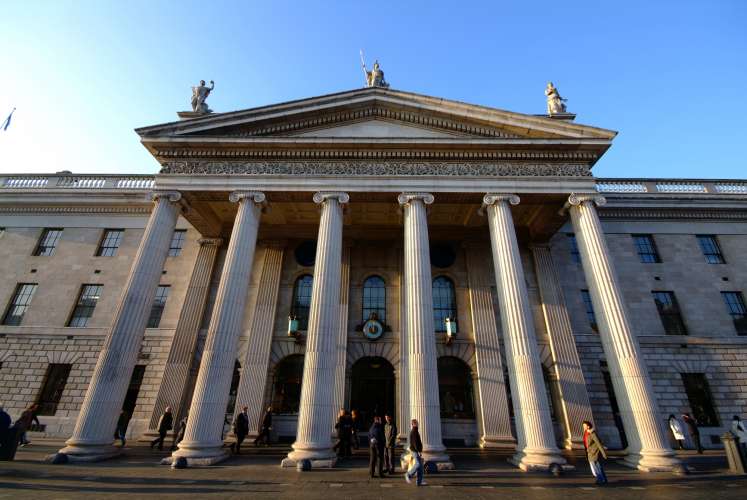
The Chester Beatty Library is covered above in the Dublin Castle entry but deserves its own mention as a potential main event rather than a supporting act: the manuscript and book collection is world-class and free, and an afternoon spent there is not wasted. The General Post Office on O’Connell Street, where the 1916 Rising was proclaimed and the exterior columns still carry the bullet holes from the ensuing British bombardment, is the most symbolically charged building in Irish public life and takes twenty minutes to walk around, including the exhibition inside.
For a day out of the city, the Wicklow Mountains are an hour south by bus and contain Glendalough, a 6th-century monastic site in a glacial valley that is one of the most atmospheric early Christian sites in Ireland and considerably less visited than its counterpart at Clonmacnoise. The Cliffs of Moher and the Burren in County Clare are three hours west; the Ring of Kerry is three and a half south. None of these are day trips in any conventional sense, but the Irish bus and coach network makes multi-day excursions from Dublin manageable, and the interior of the country is worth the effort.